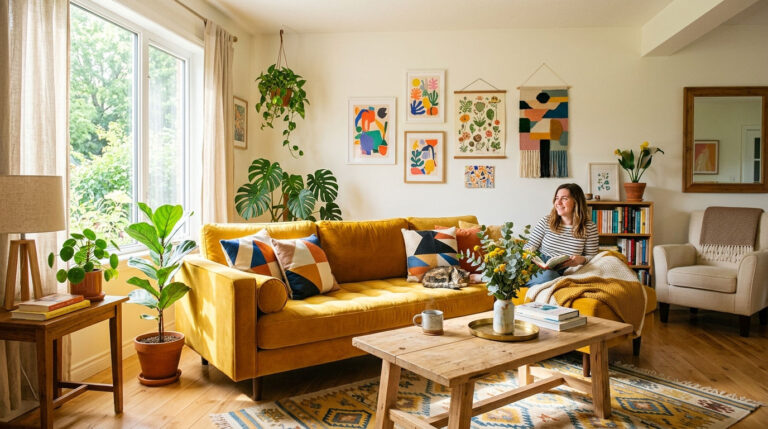
How to Choose Between a 2-Seater and 3-Seater Sofa for Your Living Room
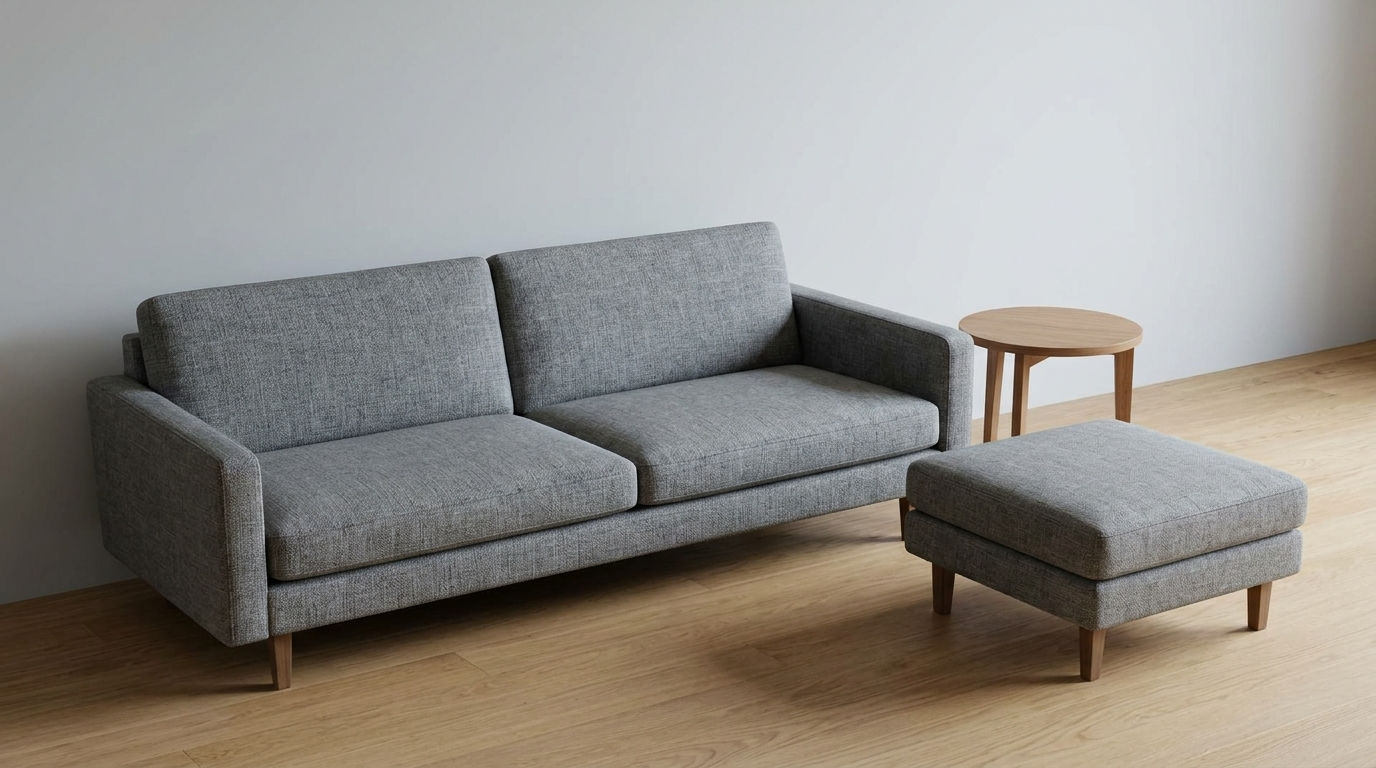
It seems like it should be a simple decision. Two seats or three. How hard can it be?
In practice, the choice between a 2-seater and 3-seater sofa is one that trips up a surprising number of buyers — people who measure the room, like two different sofas, make a gut call, and then spend months wondering whether they chose correctly. The seat that’s slightly too big for the room. The loveseat that’s slightly too small for the household. The sofa that’s comfortable for two people but awkward for three.
Getting this decision right requires thinking through a few things that aren’t obvious at the point of purchase: how your household actually uses the sofa day to day, how often you genuinely entertain, how the sofa will interact with the rest of your room’s layout, and what the proportional difference between the two sizes actually looks like in your specific space.
This guide walks you through all of it — methodically and practically — so you can make the right call the first time.
Start With the Numbers: What’s the Actual Size Difference?
Before anything else, it helps to understand exactly what you’re choosing between in terms of physical dimensions.
Typical 2-Seater Sofa Dimensions
A standard 2-seater sofa — also commonly called a loveseat — typically measures:
- Width: 51 to 67 inches (130 to 170 cm)
- Depth: 32 to 36 inches (81 to 91 cm) overall
- Seat depth: 19 to 22 inches (48 to 56 cm)
- Height: 32 to 36 inches (81 to 91 cm) to top of back cushion
These dimensions vary by manufacturer and style — a 2-seater with thick, padded arms will be narrower in usable seating width than one with slim arms, even at the same overall dimension.
Typical 3-Seater Sofa Dimensions
A standard 3-seater sofa typically measures:
- Width: 70 to 90 inches (178 to 229 cm)
- Depth: 34 to 38 inches (86 to 97 cm) overall
- Seat depth: 20 to 24 inches (51 to 61 cm)
- Height: 33 to 36 inches (84 to 91 cm) to top of back cushion
Note that compact or “apartment” 3-seaters often come in at the lower end of this range — around 70 to 78 inches (178 to 198 cm) — which significantly narrows the gap with a large 2-seater.
The Real-World Difference
The width difference between a mid-range 2-seater (around 60 inches / 152 cm) and a mid-range 3-seater (around 80 inches / 203 cm) is typically 18 to 24 inches (45 to 60 cm). That’s a foot and a half to two feet — meaningful in any room, and potentially decisive in a small one.
But that number only tells part of the story. A 2-seater and a 3-seater don’t just differ in width — they often differ in depth, height, visual weight, and the way they interact with the proportions of a room. Understanding those differences is what this guide is really about.
The Five Questions That Determine the Right Choice
Rather than looking at the decision as simply “which size fits,” it’s more useful to think through five distinct questions. Your answers will point clearly toward one option or the other.
Question 1: How Many People Actually Use the Sofa Daily?
This sounds obvious, but most people answer it wrong — because they answer based on their household’s maximum capacity rather than its daily reality.
Think about a typical Tuesday evening. Who is sitting on the sofa? Is it one person? Two? A couple and a child? Two adults and a dog? That daily reality is a better guide to what you need than the occasional Sunday afternoon when everyone is home at once.
If one or two people use the sofa daily: A 2-seater is perfectly adequate for day-to-day life. Two people sitting on a loveseat is comfortable — there’s no wasted space and no sense of rattling around in an oversized piece. This is particularly true for couples without children, single-person households, or anyone who works from home and uses the sofa primarily alone.
If three or more people use the sofa daily: A 3-seater becomes significantly more practical. Three adults on a 2-seater is a squeeze — workable for short periods but uncomfortable as a long-term daily arrangement. If you have children who sit with you, a partner who sprawls, or a household of three adults, the 3-seater is almost certainly the right choice.
The honest audit: Spend a week noticing how many people actually occupy your current sofa (or where you’d imagine sitting) at any given time in the evening. That pattern is more revealing than any hypothetical.
Question 2: How Often Do You Genuinely Entertain?
Entertaining is the argument most people make for buying a 3-seater when a 2-seater would serve their daily life better. “What about when people come over?” is the question that upgrades sofas across the world — sometimes correctly, sometimes unnecessarily.
To answer it honestly, consider:
How often do you have guests? If you host regularly — dinner parties, family gatherings, friends staying over at weekends — additional seating capacity matters. A 3-seater gives you significantly more flexibility when the room needs to accommodate five or six people.
Where do guests actually sit? In most homes, guests don’t all pile onto the sofa. They distribute across the sofa, an armchair, a dining chair pulled through, a floor cushion. The sofa rarely needs to seat everyone at once. If this reflects how you entertain, the seating capacity difference between a 2-seater and 3-seater may be less decisive than it seems.
Could additional seating solve the problem instead? An accent chair, a pair of stools, or a well-chosen ottoman can add seating for guests without requiring a larger sofa. If your day-to-day need is genuinely for two people but you occasionally need more seating, supplementary pieces may be a smarter solution than sizing up the sofa.
The honest answer: If you entertain more than twice a month and guests regularly need living room seating, factor the 3-seater’s extra capacity into your decision. If you entertain occasionally and guests could sit elsewhere, don’t let the hypothetical guest determine a purchase that affects your daily life every single day.
Question 3: What Does Your Room Allow?
Room size and layout often make the decision for you — or at least set hard limits within which the preference question operates.
The Room Size Reality
As a rough guide:
Small rooms (under 10 ft / 300 cm wide): A 3-seater will almost certainly dominate the space. In rooms this compact, a 2-seater or a compact apartment sofa is usually the only proportionate choice. Anything wider and you’ll be left with inadequate walkway clearance or a room that feels overwhelmed.
Medium rooms (10 to 13 ft / 300 to 395 cm wide): This is the zone where both options are viable and personal preference can genuinely drive the decision. A compact 3-seater can work beautifully here with careful furniture arrangement. A 2-seater with an additional chair or ottoman often works even better, giving you more layout flexibility.
Larger rooms (13 ft / 395 cm wide and above): In a genuinely large room, a 2-seater on its own can look underwhelming — too small to anchor the space, too slight to provide the visual weight a living room centrepiece needs. A 3-seater is usually the more proportionate choice.
Measuring for Both Options
Before making a final decision, measure your room and apply clearances for both sofa sizes:
- Mark out the footprint of the 2-seater with painter’s tape on your floor
- Mark out the footprint of the 3-seater alongside it
- Apply standard clearances: 14 to 18 inches (35 to 45 cm) between sofa and coffee table; 30 to 36 inches (75 to 90 cm) for main walkways
- Check whether both options leave adequate clearance for comfortable movement
In many cases, this exercise makes the decision obvious. Either one option clearly works and the other clearly doesn’t — or both work and the decision moves to preference and lifestyle.
Layout Flexibility
A 2-seater is a more flexible piece of furniture in terms of room layout. Its smaller footprint means it can be positioned in more configurations — at an angle, floating in the room, paired with an armchair in an L-arrangement, or pushed into a corner without dominating it. A 3-seater tends to dictate its own position more forcefully — it almost always needs to go against a wall or along the room’s longest axis.
If your room is an awkward shape or you like rearranging furniture, the 2-seater’s versatility is a genuine advantage.
Question 4: Are You Planning to Use It Alone or with Additional Seating?
One of the most common mistakes in sofa buying is treating the sofa as the only seating piece in the room — when in most well-designed living rooms, it’s one element in a broader furniture arrangement.
The sofa as a standalone piece: If the sofa is the only seating in your living room — no armchairs, no ottoman, no additional chairs — then the 3-seater’s greater seating capacity becomes more important. Without supplementary seating, the sofa has to do all the work.
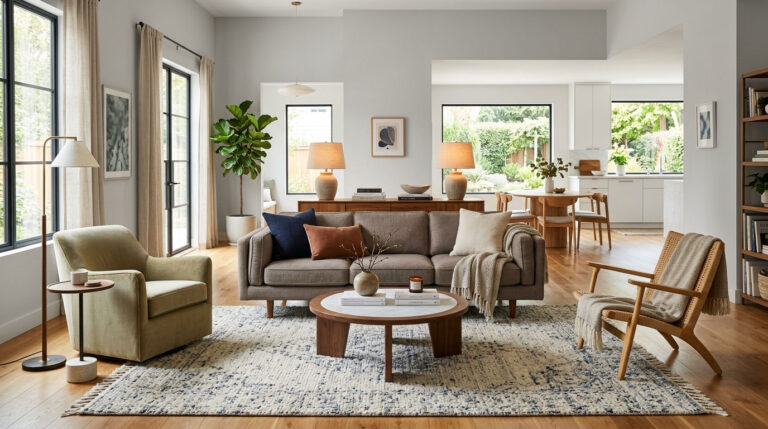
The sofa as part of a furniture group: If you’re planning to pair the sofa with an armchair, a pair of accent chairs, or an ottoman that can serve as additional seating, a 2-seater often makes more sense as the anchor piece. The overall seating capacity of the room comes from the group rather than the sofa alone — and a 2-seater paired with two good armchairs typically provides more comfortable seating for four people than a 3-seater alone.
This is also a proportional consideration: a 2-seater and two armchairs creates a more balanced, designed arrangement than a 3-seater and two armchairs, which can feel weighted heavily toward one piece.
The paired 2-seater arrangement: Some rooms work beautifully with two 2-seaters facing each other across a coffee table — a classic arrangement that provides seating for four in a symmetrical, conversational layout. This only works if the room is wide enough, but where it does work it’s one of the most elegant living room arrangements available. Two 2-seaters give you the same total seating as a 3-seater plus an armchair, often in a more versatile and visually balanced configuration.
Question 5: What’s Your Budget — and How Does It Affect Value?
The price difference between a 2-seater and a 3-seater from the same manufacturer typically ranges from 15 to 30 percent, with the larger sofa costing more. But this isn’t simply a case of “bigger equals better value for money” — it requires some nuance.
If budget is a constraint: A well-made 2-seater is a better investment than a poorly made 3-seater at the same price. The frame quality, foam density, and fabric durability matter more than the size. Don’t stretch to a 3-seater by sacrificing quality — a high-quality 2-seater will outlast and outperform a budget 3-seater significantly.
If quality is equal: When comparing a 2-seater and a 3-seater of identical construction quality, the 3-seater represents reasonable value for the additional cost — you’re getting meaningfully more seating and more physical sofa for a proportionally smaller price increase.
The hidden cost factor: A larger sofa may require a larger coffee table to maintain visual proportion, a larger rug to anchor the seating group, and additional cushions to dress it effectively. These peripheral costs can add up. Factor them in when comparing the true cost of each option.
The longevity consideration: If your living situation is likely to change — moving to a larger home, having children, sharing with more people — and you’re buying a sofa you intend to keep for ten or more years, buying slightly more sofa than you currently need may be the smarter long-term decision. The opposite is equally true: if you expect to downsize or move frequently, a 2-seater is more adaptable across a range of room sizes.
Specific Scenarios: Which Size Works Better?
Rather than continuing in the abstract, here are specific life situations and the sofa size that typically serves each one best:
Single person living alone in a flat or apartment: A 2-seater is almost always sufficient. A 3-seater will likely dominate a smaller space and provides seating you’ll rarely need. The 2-seater gives you room to stretch out comfortably and leaves floor space for other furniture or movement.
Couple without children: Either option can work depending on room size and personal preference. Couples who both like to stretch out on the sofa simultaneously often find a 3-seater works better — there’s room for both of them to spread out without negotiating space. Couples who sit together comfortably on a loveseat, or who have a small living room, are well served by a 2-seater.
Couple with one or two young children: A 3-seater is almost always the better choice. Young children tend to sit with parents rather than on separate chairs, which means the sofa needs to accommodate the full family unit simultaneously. A 2-seater with two adults and a child is a tight squeeze that only gets more complicated as children grow.
Household of three adults: Three adults living together sharing a living room almost always need a 3-seater as the primary sofa. Three adults on a 2-seater is genuinely uncomfortable for extended use — someone will always feel slightly short-changed on space.
Frequent entertainers: If you regularly host four or more people in your living room and everyone needs a seat, the 3-seater’s additional capacity is valuable. Pair it with at least one armchair or an ottoman for flexibility.
Someone who works from home and uses the sofa as a secondary workspace: A 2-seater or compact 3-seater works well — you need a comfortable place to sit with a laptop but not necessarily full family seating. The more important consideration is seat depth (shallower is better for upright working) than width.
Someone with a small living room who also needs occasional guest seating: A compact 3-seater paired with a nesting ottoman or a foldable chair stored out of sight gives the best of both worlds — comfortable daily seating without permanently occupying floor space for guest accommodation.
The Case for the 2-Seater
The 2-seater wins on:
Space efficiency — consistently the better choice for small rooms, awkward layouts, and anyone who needs flexibility in how the room is arranged.
Versatility in pairing — a 2-seater works with more furniture arrangements and is easier to balance against other pieces, particularly armchairs.
Visual lightness — a 2-seater has less visual mass, which keeps smaller rooms feeling open and allows other elements — art, a rug, a coffee table — to share the room’s visual attention.
Budget — consistently less expensive, both upfront and in the peripheral costs (coffee table scale, cushions, rug size) that come with a larger sofa.
Adaptability — easier to move between homes of different sizes, easier to reconfigure within the same room, and easier to replace or supplement as needs change.
The Case for the 3-Seater
The 3-seater wins on:
Daily seating capacity — if three or more people are using the sofa regularly, there’s no substitute for the additional space a 3-seater provides.
Comfort for lying down — a 3-seater gives most adults enough room to lie full length comfortably. A 2-seater typically doesn’t, unless you’re quite short.
Visual anchoring — in medium to large rooms, a 3-seater provides the visual weight needed to anchor the seating group and give the room a proper centrepiece. A 2-seater in a large room can look underwhelming and proportionally mismatched.
Long-term flexibility — if your household is likely to grow or your social life expand, buying slightly more sofa than you currently need is an easier decision to live with than buying too little.
Solo sprawling — one person who likes to truly stretch out — legs up, horizontal, fully sprawled — is always more comfortable on a 3-seater. The 2-seater works for curling up; the 3-seater works for genuine horizontal relaxation.
What If You’re Still Not Sure? The Painter’s Tape Test
If you’ve worked through all five questions and you’re still genuinely undecided, do this before buying:
Use painter’s tape to mark out both footprints on your floor — the 2-seater dimensions on one side, the 3-seater dimensions alongside. Apply the clearance distances around each. Walk through the room. Sit in the space. Look at each from the doorway.
Then leave the tape down for 48 hours and live around both footprints. By the end of two days, one will almost always feel obviously right and the other obviously wrong — not from measurement or logic, but from the physical experience of navigating the space.
This test has a high success rate at breaking genuine indecision. The body knows things the measuring tape doesn’t.
Quick Decision Guide
Use this as a final reference:
| Situation | Recommended Choice |
|---|---|
| Room under 10 ft / 300 cm wide | 2-seater |
| Room 10–13 ft / 300–395 cm wide | Either — measure and test both |
| Room over 13 ft / 395 cm wide | 3-seater |
| One or two people using daily | 2-seater |
| Three or more people using daily | 3-seater |
| Frequent entertainers (2+ times/month) | 3-seater |
| Occasional entertainers | 2-seater + supplementary seating |
| Pairing with armchairs | 2-seater |
| Sofa as only seating | 3-seater |
| Need to lie full length | 3-seater |
| Budget is a primary constraint | 2-seater (prioritise quality) |
| Likely to move or downsize | 2-seater |
| Household likely to grow | 3-seater |
Final Thoughts
The right choice between a 2-seater and a 3-seater isn’t about which is objectively better — it’s about which is better for your specific room, your specific household, and your specific way of living.
The 2-seater is the smarter choice more often than buyers give it credit for — particularly in smaller rooms, in arrangements paired with other seating, and in households of one or two people who spend most evenings with just each other. Its flexibility, lighter visual weight, and lower cost make it underrated.
The 3-seater earns its place in larger rooms, in households of three or more, and anywhere the sofa needs to do the heavy lifting as the room’s primary and often only seating piece. Its greater capacity and stronger visual presence make it the right choice for a significant proportion of buyers.
Most importantly: be honest about how you actually live rather than how you imagine you might live. The sofa that serves your real daily life will always outperform the one you bought for the occasional scenario that might never come.

Sarah Rose writes for EcoGardeningHub, sharing eco home decor ideas, sustainable styling tips, and simple ways to create beautiful, nature-inspired living spaces with a mindful, environmentally friendly approach.