Sofa vs Couch: What’s the Difference and Does It Matter?
At some point, almost everyone stops mid-sentence and wonders: am I sitting on a sofa or a couch? Should I be calling it one thing and not the other? Is there actually a difference — or is this one of those distinctions that sounds meaningful but dissolves completely the moment you look closely?
The honest answer is: it depends on who you ask and where you are. To a linguist, the two words have distinct historical roots. To an interior designer, there are subtle connotations that still influence how each word is used professionally. To a furniture retailer, the terms are largely interchangeable. And to most people in everyday conversation, sofa and couch mean exactly the same thing and always have.
This article unpacks all of it — the etymology, the regional differences, the design-world conventions, and the practical question of whether any of this actually matters when you’re buying one. It’s a surprisingly interesting rabbit hole for what seems like a simple question.
Where Did the Words Come From?
Understanding the difference — to the extent that one exists — starts with where each word came from.
The Word “Sofa”
Sofa has a long and well-travelled history. It derives from the Arabic word suffah, which referred to a raised platform or bench covered with cushions and rugs — a place of repose in traditional Arabic homes and public spaces. The word travelled through Turkish (sofa) and French (sopha) before entering the English language in the late 17th century.
From its earliest use in English, “sofa” carried connotations of formality, elegance, and refinement. It described a specific type of upholstered seat — long enough for reclining, designed for comfort, intended as a piece of furniture worthy of a formal room. The word’s exotic origins gave it a slightly elevated tone that it has retained, to varying degrees, ever since.
The Word “Couch”
Couch has a different lineage. It comes from the Old French word couche, derived from the verb coucher — meaning to lie down. That French root, in turn, traces back to the Latin collocare, meaning to place or lay out.
The word entered Middle English in the 14th century and initially referred quite specifically to a piece of furniture for lying down — something closer to a daybed or reclining seat than what we’d recognise as a sofa today. Early couches often had only one armrest and a partially raised back at one end, designed for reclining rather than upright sitting.
Over time, as furniture design evolved and the two pieces began to converge in form, the words were increasingly used interchangeably. But the original association of “couch” with lying down — with informality, rest, and horizontal ease — has never entirely disappeared from how the word feels in use.
Are They Actually Different Pieces of Furniture?
Historically, the answer is a qualified yes. Today, the answer is mostly no — but with some interesting nuances still observed in certain contexts.
The Traditional Distinction
In the more formal traditions of furniture history and interior design, a distinction between sofa and couch does exist — or at least did exist — and it centres on two things: armrests and intended use.
A sofa, in the traditional sense, has two armrests, a full back, and is designed primarily for upright sitting. It is a formal piece of furniture — the centrepiece of a drawing room or parlour, intended to convey status and hospitality. You sit on a sofa. You entertain on a sofa.
A couch, in the traditional sense, may have only one armrest (or none at all) and a partially raised or fully flat back at one end — designed for reclining. The daybed, the chaise longue, and the fainting couch all belong to this lineage. You lie on a couch. You rest on a couch.
In this framework, the two pieces serve meaningfully different purposes and belong to different categories of furniture. The sofa is social; the couch is private. The sofa is formal; the couch is informal.
What Happened to the Distinction
The distinction began to blur as furniture design evolved through the 18th and 19th centuries and the modern upholstered sofa — with two arms, a full back, and cushioned seating for multiple people — became the dominant form of living room furniture. As this piece came to be called both “sofa” and “couch” interchangeably in everyday speech, the functional distinction became increasingly academic.
By the 20th century, most furniture retailers and manufacturers were using the terms without any consistent differentiation. The same piece of furniture — a standard three-seater with two arms and a full back — would be listed as a “sofa” in one catalogue and a “couch” in another, with no meaningful difference between them.
Today, if you walk into a furniture store and ask for a couch, you will be shown sofas. If you ask for a sofa, you will be shown the same pieces. The words refer to the same product.
Regional Differences: Where You Live Shapes What You Say
One of the most consistent and well-documented differences between “sofa” and “couch” is not about the furniture itself but about geography — specifically, where in the English-speaking world you happen to live.
United States and Canada
In North America, “couch” is by far the more common word in everyday speech. American and Canadian English speakers reach for “couch” instinctively in casual conversation — you crash on the couch, you watch TV on the couch, you find loose change between the couch cushions. “Sofa” exists and is understood, but it tends to feel slightly more formal or old-fashioned in everyday American usage.
Linguists and lexicographers who have studied American regional dialects have found that “couch” dominates across most of the United States, with “sofa” appearing more frequently in certain regional dialects and among older speakers. The word “davenport” — a term for a large sofa that was common in the early-to-mid 20th century — also appears in some parts of the American Midwest, though it has largely fallen out of use.
United Kingdom and Australia
In British and Australian English, “sofa” is significantly more common in everyday speech than it is in North America. British speakers tend to refer to their living room centrepiece as a sofa by default, with “couch” feeling slightly more casual or informal — often used specifically to imply lying down (“I was lying on the couch all afternoon”) rather than as a general-purpose synonym.
This isn’t a hard rule — both words are widely used and understood throughout the UK and Australia — but the preference for “sofa” in more neutral contexts is noticeably stronger than in American English.
Ireland
In Ireland, neither “sofa” nor “couch” is the most common term. Many Irish speakers default to “settee” — an older English word for an upholstered seat for multiple people, derived from the word “settle.” “Settee” has fallen largely out of use elsewhere in the English-speaking world but remains common in Ireland and parts of Northern England.
A Note on “Settee” and “Davenport”
While we’re on the subject of alternative terms: “settee” was widely used throughout Britain until the mid-20th century and is still heard in some regional dialects. “Davenport” was common in parts of the United States and Canada during the early 20th century. Neither is the dominant term anywhere today, but both reflect the same underlying reality — that different communities have always named this piece of furniture differently, and none of those names is inherently more correct than any other.
How the Design World Uses the Terms
Interior designers, furniture makers, and design publications tend to use the terms with slightly more intention than everyday speakers — though even here, usage is far from uniform.
“Sofa” as the Default Professional Term
In professional interior design and the furniture industry, “sofa” tends to be the default term for the main upholstered seating piece in a living room. Design catalogues, specification sheets, and professional communication almost universally use “sofa” when describing a standard two- or three-seat upholstered piece. It carries an air of formality and precision that “couch” lacks in professional contexts.
If you read Architectural Digest, Elle Decor, or any major interior design publication, you will encounter “sofa” far more frequently than “couch.” The word signals a degree of seriousness about the subject — a subtle but consistent professional preference.
“Couch” as an Indicator of Informality
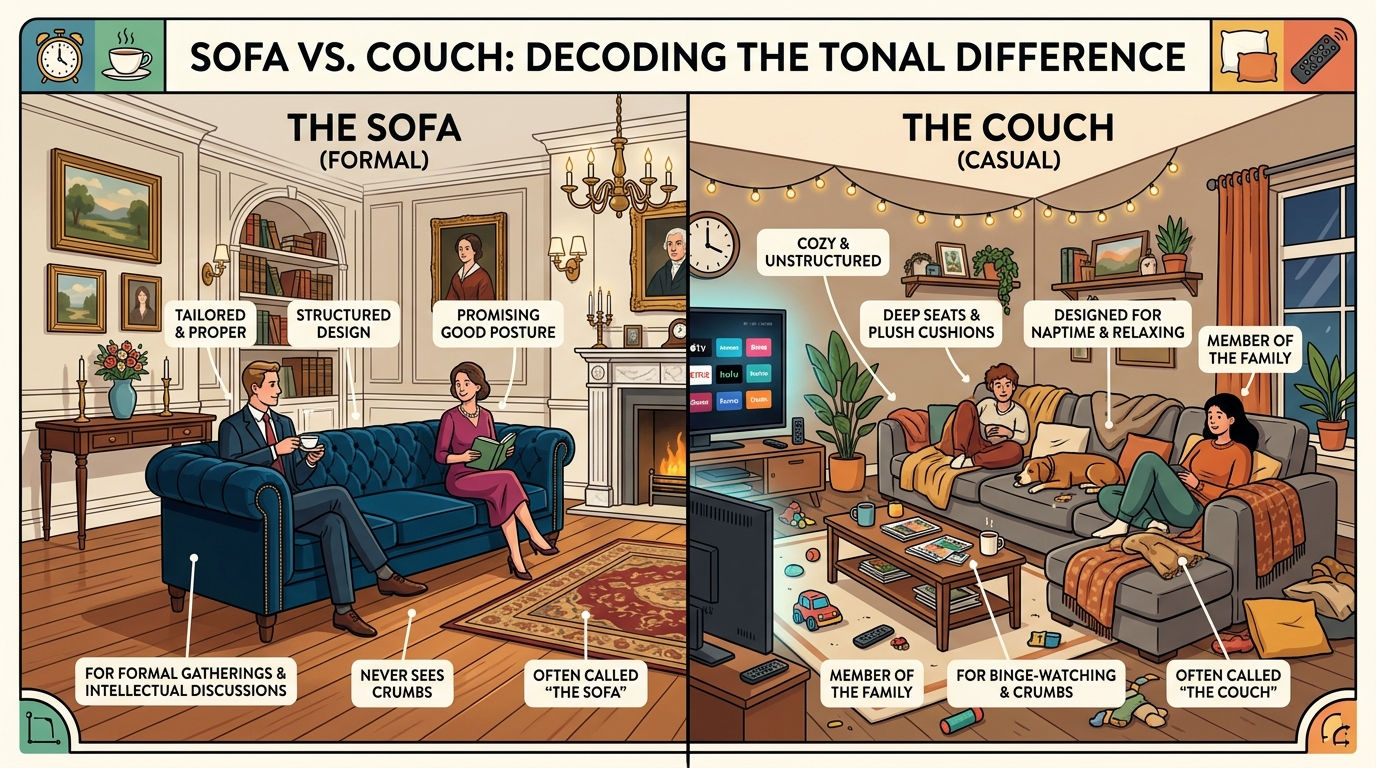
In design contexts, “couch” tends to appear more often when the intent is to convey informality, casualness, or comfort-over-formality. A relaxed family room with low-slung, overstuffed seating might be described as having a “couch”; a formal sitting room with a structured, tailored piece would almost certainly have a “sofa.” The words are doing subtle tonal work even when they’re describing physically similar objects.
This isn’t a rule that every designer follows consciously — many use both words without distinction — but it reflects the residual tonal difference between the two words that has never entirely gone away.
Specific Furniture Types Where the Distinction Persists
There are a handful of specific furniture categories where the language has retained clearer distinctions:
The chaise longue (or chaise lounge): This is unambiguously in the “couch” tradition — a piece designed primarily for reclining, often with one raised end, minimal or no armrests. Nobody calls a chaise longue a sofa.
The fainting couch: A Victorian-era reclining piece with a raised back at one end and a sloped or flat surface for lying on. Again, firmly a “couch” in name and function — the name is inseparable from the piece.
The daybed: Designed for lying down rather than sitting upright. Another piece that belongs firmly in the “couch” lineage by function, even if the word isn’t always used.
The settee: In some antique and traditional furniture contexts, “settee” is used for smaller, more formal upholstered benches — a narrower and more specific term than either sofa or couch.
What Do People Actually Search For?
From a purely practical standpoint, search data tells an interesting story about how people actually use these words.
In the United States, “couch” consistently outperforms “sofa” as a search term — Americans are more likely to search “couch covers,” “couch cushions,” and “couch cleaner” than the sofa equivalents. In the United Kingdom, the opposite tends to be true — “sofa” dominates search queries related to furniture buying, cleaning, and styling.
Furniture retailers operating internationally have largely adapted to this reality by using both terms strategically — “sofa” in their formal product listings and design-focused content, “couch” in casual-tone marketing, lifestyle content, and any material aimed at North American audiences.
This dual-term strategy reflects something real: neither word is going away, both are understood everywhere, and the choice of which to use is primarily a matter of context, audience, and tone rather than any meaningful difference in what’s being described.
Does It Actually Matter?
For most purposes — no. If you ask a furniture salesperson for a couch, you will be shown sofas. If you ask an interior designer about your sofa, they will understand you completely if you call it a couch. If you tell a friend you’re watching TV on your sofa, they won’t picture anything different than if you’d said couch.
The functional distinction that once existed — couch for reclining, sofa for sitting — has been so thoroughly eroded by centuries of overlapping usage that it no longer serves as a reliable guide to what either word means.
The regional distinction is real and worth being aware of — particularly if you’re writing for an international audience or operating in a market where one term strongly dominates. Using “couch” in a British context can feel faintly American; using “sofa” in casual American conversation can feel slightly formal. These are subtle signals, but they’re real ones.
The tonal distinction — sofa for formal, couch for casual — is also real in a soft sense. If you want your living room to sound designed and considered, “sofa” is probably the word to use. If you want it to sound relaxed and inviting, “couch” does that slightly better.
But in terms of what piece of furniture you’re actually getting? None of this matters at all. A sofa by any other name is just as comfortable — or uncomfortable — to sit on.
A Brief Timeline: How the Words Evolved
Understanding the journey of both words across the centuries puts the current situation in perspective:
14th century: “Couch” enters Middle English from Old French couche — referring to a piece of furniture for lying down, often with one raised end.
Late 17th century: “Sofa” enters English from Arabic via Turkish and French — referring to an elegant, cushioned seat associated with formal rooms and elevated status.
18th century: Both words in common use in English, with some distinction maintained — sofa for formal upright seating, couch for reclining pieces. Furniture design begins producing pieces that blur the categories.
19th century: The fully upholstered, two-armed, cushioned sofa becomes the dominant living room furniture form. Both words increasingly applied to the same piece. “Settee” also widely used in British English.
Early 20th century: “Davenport” enters common use in parts of North America as another term for a large sofa. Regional variation in terminology becomes more pronounced.
Mid 20th century: “Couch” becomes firmly dominant in American English for everyday speech. “Sofa” remains the preferred term in British English. “Settee” begins declining in British usage.
Late 20th century to present: Furniture retailers and manufacturers use both terms interchangeably. Design publications favour “sofa.” Casual speech in North America favours “couch.” Both words are understood globally. The functional distinction is effectively gone.
So What Should You Call It?
Call it whatever comes naturally — because whatever you call it, everyone will know exactly what you mean.
If you’re writing about furniture professionally or for a design-conscious audience, “sofa” is the safer, more universally formal choice. If you’re speaking casually with American friends, “couch” will feel more natural. If you’re in Ireland, “settee” might get a knowing nod from older relatives.
If you’re buying one, neither word will affect what you end up with. The salesperson, the delivery driver, and the piece of furniture itself are entirely indifferent to the terminology. What matters is whether it’s the right size for your room, made from the right materials, and comfortable enough to spend years sitting — or lying — on.
The sofa-couch debate is, in the end, a charming linguistic curiosity rather than a question with a definitive answer. Both words have long histories, both carry subtle tonal shades, and both describe the same essential thing: the most important seat in the house.
The Verdict
Are they different pieces of furniture? Historically, yes — with meaningful distinctions around armrests, back height, and intended use. Today, no — the terms refer to the same piece in virtually all retail and everyday contexts.
Does the regional difference matter? Yes, in subtle ways — “couch” feels more natural in North American casual speech; “sofa” is the dominant term in British English and professional design contexts worldwide.
Does the tonal difference matter? A little — “sofa” carries a slightly more formal, designed feel; “couch” is warmer and more casual. Neither is wrong; both are useful depending on the effect you want.
Does it matter when you’re buying one? Not even slightly. Buy the one that fits your room, suits your life, and feels right to sit on. Call it whatever you like.

Sarah Rose writes for EcoGardeningHub, sharing eco home decor ideas, sustainable styling tips, and simple ways to create beautiful, nature-inspired living spaces with a mindful, environmentally friendly approach.