How to Arrange Sofas in a Living Room: Layout Rules for Every Space
The way you arrange your sofa — or sofas — in a living room has more impact on how the space feels than almost any other design decision. Get it right and the room flows naturally, feels comfortable, and works for both everyday living and socialising. Get it wrong and even the most beautiful furniture can make a room feel awkward, cramped, or oddly disconnected.
The good news is that sofa arrangement is not guesswork. There are clear, proven principles that work across different room shapes, sizes, and styles. Whether you are working with a small apartment living room, a large open-plan space, or an oddly shaped room that has never quite made sense, this guide will walk you through the layout rules, the most effective configurations, and how to adapt them to your specific situation.
Start Here: The Principles That Apply to Every Layout
Before diving into specific configurations, there are a handful of universal principles that apply regardless of room size, shape, or sofa type. These are the rules that professional interior designers rely on, and they are worth understanding thoroughly before you move a single piece of furniture.
Define the room’s purpose first
Before deciding where to put the sofa, decide what the room needs to do. Is it primarily a space for relaxing and watching television? A social room for entertaining guests? A dual-purpose family room that handles both? A formal sitting room that is used occasionally?
The answer to this question determines the orientation of the sofa, the focal point it should face, and the spacing between pieces. A room designed for television watching requires a different layout to one designed primarily for conversation.
Identify the focal point
Every living room needs a focal point — the dominant visual element that the room’s layout is organised around. Common focal points include a fireplace, a television and media unit, a large window with a view, or a piece of statement art or furniture.
The sofa should generally face or angle toward the focal point. If the room has more than one potential focal point — a fireplace on one wall and a television on another, for example — decide which takes priority and arrange the seating around that one. Trying to face both simultaneously usually results in a layout that serves neither well.
Allow adequate circulation space
Walkways through and around the seating area need to be wide enough to move through comfortably without squeezing. The minimum clearance between any piece of furniture and an adjacent wall, another piece of furniture, or a high-traffic pathway is 75 cm. In family homes and rooms that see heavy foot traffic, aim for 90 cm or more.
The pathway between the sofa and the coffee table is a particular consideration. Leave a minimum of 40 to 50 cm between the front edge of the sofa and the edge of the coffee table — enough for comfortable legroom and for people to pass in front of the seating without stepping over anyone.
Keep the sofa in proportion with the room
A sofa that is too large for the room will block pathways, overwhelm the space, and make the room feel smaller than it is. A sofa that is too small will look lost, leave awkward empty space, and fail to anchor the room.
The two-thirds rule is the most reliable guideline for proportion: your sofa should ideally take up no more than two-thirds of the wall it faces or sits against. Apply this principle to both the sofa’s width relative to the wall and its visual mass relative to the overall room.
Anchor with a rug
In most living room layouts, a rug plays a critical role in defining and anchoring the seating area. As a general rule, at least the front legs of the sofa should sit on the rug. Ideally, the rug extends under all four legs of the sofa and any accompanying chairs or secondary seating. A rug that is too small — where the sofa sits entirely off it — will make the whole layout look disconnected and unresolved.
The Most Common Sofa Layout Configurations
The Classic Single Sofa Layout
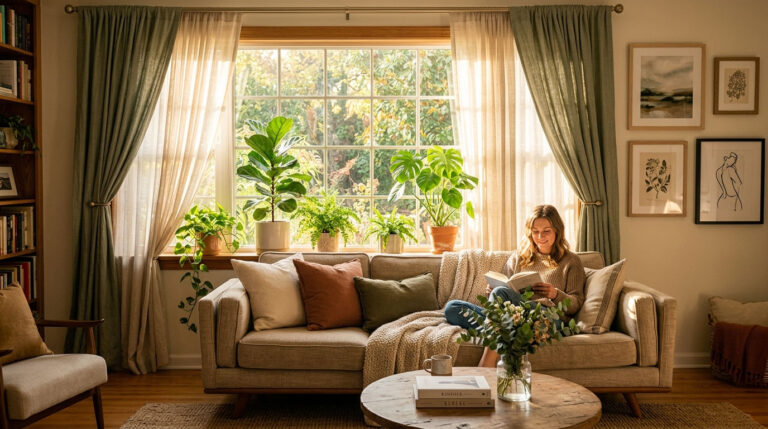
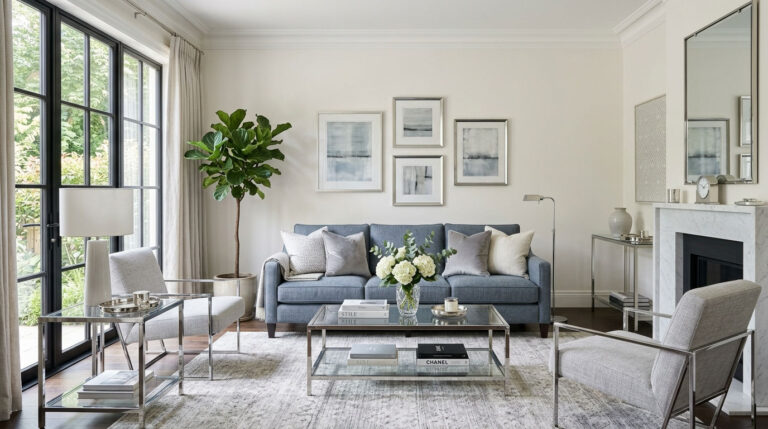
The simplest and most common arrangement — a single sofa positioned facing the room’s focal point, typically with a coffee table in front and armchairs or other seating completing the grouping.
This layout works well in small to medium living rooms where space is limited. The sofa becomes the anchor, and additional seating elements are arranged around it in a way that creates a cohesive conversation and viewing area.
How to make it work:
Position the sofa so it directly faces the focal point — whether that is a fireplace, television, or window. Pull it away from the wall by 30 to 60 cm rather than pushing it flat against it. This seemingly counterintuitive move creates a sense of space behind the sofa and makes the seating feel more intentional and relaxed. It also creates an opportunity to place a console table behind the sofa for additional surface space and visual layering.
Complement the sofa with one or two armchairs positioned at a slight angle — not perfectly parallel to the sofa, but angled in slightly toward the centre of the seating area. This encourages conversation without making the room feel like a formal waiting area.
Best for: Small to medium living rooms, apartments, rooms with a single clear focal point.
The Two-Sofa Facing Layout
Placing two sofas directly opposite each other — facing one another across a shared coffee table — creates one of the most elegant and social living room arrangements possible. It is symmetrical, balanced, and naturally conversation-friendly.
This is a classic layout in both traditional and contemporary interiors and works particularly well in rooms with a fireplace or other central focal point on one of the shorter walls.
How to make it work:
The two sofas should ideally be identical, or at least very similar in scale and visual weight, to maintain the symmetrical balance. Position them facing each other with a shared coffee table or pair of smaller tables between them. Leave 90 cm to 120 cm between the two sofas — enough for legroom and comfortable passage, but close enough to allow easy conversation across the gap.
Position the arrangement so both sofas can comfortably face a shared focal point. In rooms with a fireplace, this typically means placing the arrangement perpendicular to the fireplace wall, with both sofas able to angle slightly toward it.
If the two sofas are of different sizes — for example, a 3-seater and a 2-seater — place the larger sofa on the side away from the most-used room entrance, and the smaller sofa closer to the entry point. This keeps the visual balance while accommodating the size difference.
Best for: Medium to large living rooms, rooms with a fireplace or prominent focal point, formal and social living spaces, entertaining-focused homes.
The L-Shaped Layout
An L-shaped layout uses either a corner sectional sofa or a regular sofa paired with a chaise lounge or loveseat arranged at a right angle, forming an L-shape around a shared central area.
This configuration is one of the most space-efficient arrangements available. It makes excellent use of corner space, provides generous seating, and creates a naturally enclosed, cosy feeling in the seating area.
How to make it work:
Position the corner of the L in the corner of the room. This is the most logical and space-efficient placement for an L-shaped arrangement — it uses the room’s geometry rather than fighting against it. The open end of the L should face the room’s focal point or the main entry point to the seating area.
If you are using a sectional sofa, confirm before buying whether you need a left-hand or right-hand facing configuration. The longer arm of the L should run along the longer wall of the room in most cases, with the shorter arm perpendicular.
In larger rooms, the L-shape can be positioned away from the walls entirely, floating in the room and using the back of the longer arm to divide the living area from another zone — a dining area or home office, for example.
Best for: Medium to large living rooms, open-plan spaces, family homes needing maximum seating, rooms with underused corner space.
The U-Shaped Layout
A U-shaped arrangement takes the L-shape a step further by adding a third element — a third sofa, a loveseat, or a substantial bench — to close off the open end of the L and create a fully enclosed seating zone.
The result is an arrangement that feels genuinely enclosed and intimate, maximises seating capacity, and creates a strong conversation-centred layout. It is the best possible arrangement for rooms where socialising and conversation are the primary purpose.
How to make it work:
The U-shape requires a large room — generally at least 4 to 5 metres in both directions — to work without feeling cramped. In smaller rooms, the enclosed nature of the arrangement can tip from cosy to suffocating.
Place the open end of the U toward the focal point — the television or fireplace — so all three sides of the seating can engage with it. A coffee table in the centre of the U anchors the arrangement and provides a practical surface for everyone within the grouping.
Because the U-shape can be visually heavy, keep the other elements of the room light and streamlined. Wall-mounted shelving, slim-profile side tables, and lighter window treatments will all prevent the room from feeling overwhelmed by the seating.
Best for: Large living rooms, open-plan spaces, rooms primarily designed for entertaining and socialising, households that regularly host large groups.
The Floating Layout
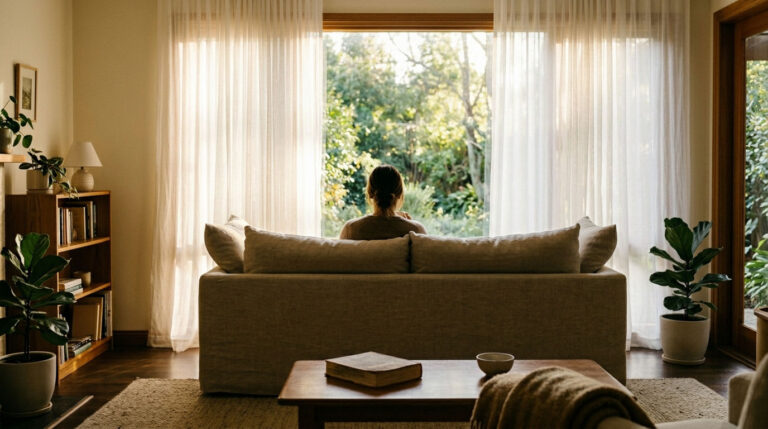
A floating layout positions the sofa away from the walls — pulled out into the room rather than pushed back against the perimeter. This is one of the most effective ways to make a living room feel more spacious, more intentional, and more professionally designed.
Many people instinctively push sofas against walls to maximise floor space, but this often has the opposite effect — it makes the room feel like a series of disconnected pieces around the perimeter rather than a cohesive, functional space.
How to make it work:
Pull the sofa at least 30 to 60 cm away from the wall behind it. In a larger room, you can pull it further — up to 90 cm or more from the wall — which creates a genuine sense of depth and allows the furniture grouping to function as its own defined zone within the room.
Use the space behind the sofa purposefully. A slim console table behind the sofa provides a surface for lamps, books, or decorative objects and gives the back of the sofa a finished, considered appearance.
Anchor the entire floating arrangement with a large area rug. Without a rug, a floating sofa grouping can look unmoored. With one, it looks intentional and complete.
Best for: Medium to large rooms, open-plan spaces, rooms where the sofa does not need to be positioned against a specific wall, anyone wanting a more designed and spacious feel.
The Angled Layout
An angled arrangement positions the sofa at a diagonal to the room’s walls rather than parallel or perpendicular to them. This is a more unconventional approach, but in the right room it creates a dynamic, interesting layout that adds genuine character.
Angled sofas work particularly well in square rooms where a perfectly parallel layout can feel rigid and predictable, and in open-plan spaces where an angled sofa can help define a seating zone and direct attention toward a focal point that is not on a directly opposing wall.
How to make it work:
Angle the sofa at approximately 45 degrees to the walls, positioning it to face the focal point from a diagonal orientation. The corner space behind the sofa — the triangle created between the sofa’s back and the two walls — can be used for a floor lamp, a plant, or a small side table, which fills the dead space and completes the look.
Because an angled sofa takes up more visual and physical space than a parallel one, ensure there is adequate clearance on all sides. The angled position can create unexpected pinch points in the circulation routes through the room — check that walkways remain at least 75 to 90 cm wide from every direction.
Best for: Square rooms, rooms where a conventional parallel layout feels predictable, open-plan spaces where a diagonal helps direct flow.
The Corner Layout
A corner layout places the sofa directly in a corner of the room — not a corner sectional, but a standard straight sofa positioned in the corner at an angle or along one wall meeting another. This is a useful approach in rooms where floor space is limited and the natural wall arrangement makes a corner position the most practical option.
How to make it work:
If placing a straight sofa into a corner position, consider using a floating placement that pulls the sofa forward from the corner rather than wedging it tightly in. Tight corners tend to make sofas feel trapped rather than intentionally placed.
Alternatively, use the corner position as the base for a small, intentional seating grouping — sofa in the corner along one wall, armchair along the adjacent wall, small coffee table or side table in the middle. This creates a natural conversation nook that suits smaller rooms particularly well.
Best for: Small rooms, rooms with limited wall length, secondary seating areas, snug or reading nook layouts.
Sofa Arrangement for Specific Room Types
Small Living Rooms
In a small living room, the priority is preserving floor space and maintaining clear sightlines. A single sofa on the wall opposite the focal point, with a compact armchair and a small coffee table, is usually the most effective arrangement.
Resist the urge to fill every corner and every wall with furniture. Empty space in a small room reads as breathing room, not waste. The room will feel larger with less furniture arranged thoughtfully than with more furniture crammed in.
Pull the sofa away from the wall by at least 10 to 20 cm — even a modest gap creates the impression of more space. Choose a coffee table that is proportional to the sofa — a small round table tends to work better than a large rectangular one in a tight space.
Avoid heavy, imposing armchairs if seating options beyond the sofa are needed. A pair of slim-profile occasional chairs, or even a stylish bench at one end of the coffee table, will provide additional seating without adding significant visual weight.
Large Living Rooms
In a large living room, the challenge is the opposite — filling the space purposefully without it feeling sparse or underutilised. A single sofa against one wall in a large room will look stranded and undersized, leaving large areas of unused floor that feel awkward and unresolved.
The solution is to create a clearly defined seating zone that occupies an appropriately scaled portion of the room. Use a large sectional or a two-sofa facing arrangement to create a substantial grouping, anchor it with a generous rug, and allow the remaining floor space to exist as purposeful breathing room rather than dead space.
In very large rooms, consider creating two distinct zones — a main seating area around the focal point and a secondary seating area in another part of the room. Two separate groupings, each with their own rug and focal arrangement, can make a large room feel considered and full of purpose rather than cavernous.
Open-Plan Spaces
Open-plan living rooms — where the living area flows into a kitchen, dining room, or other space without dividing walls — present the specific challenge of defining the living zone without physical boundaries.
The sofa is one of the most effective tools for creating this definition. Positioning a sofa with its back facing the kitchen or dining area creates a visual and psychological separation between the zones. The back of the sofa becomes a soft boundary — not a wall, but a clear signal of where one zone ends and another begins.
A large rug beneath the sofa arrangement reinforces this definition further. The rug visually grounds the living zone and makes its boundaries clear even from a distance.
Avoid positioning the sofa parallel to the kitchen counter or dining table — this creates a strange visual alignment between two zones that are meant to feel distinct.
L-Shaped and Awkward Rooms
Rooms that are unusually shaped — very long and narrow, L-shaped themselves, or with alcoves, bay windows, or chimney breast projections — often present sofa placement challenges that straightforward rules do not immediately solve.
In long, narrow rooms, resist the temptation to place the sofa across the width of the narrower dimension. This emphasises the room’s narrowness. Instead, work with the length — position the sofa along one of the long walls and create a layout that runs the length of the room rather than cutting across it.
In rooms with a bay window, the bay offers a natural opportunity for a secondary seating moment — a loveseat or a pair of chairs facing inward from the bay — while the main sofa arrangement occupies the rest of the room.
In rooms with alcoves on either side of a chimney breast, use the alcoves for storage or shelving and position the sofa to face the fireplace directly, with the arrangement centred on the chimney breast.
TV and Sofa: Getting the Relationship Right
If the television is the room’s primary focal point, the relationship between sofa and screen needs particular attention.
Optimal viewing distance
The ideal viewing distance from a sofa to a television screen is generally between 1.5 and 2.5 times the diagonal screen size. For a 55-inch television, that means a comfortable viewing distance of roughly 210 to 350 cm. For a 65-inch screen, the comfortable range is approximately 245 to 410 cm.
Sitting too close causes eye strain and makes it difficult to take in the full image. Sitting too far away means the screen feels small and details are hard to see. Measure the distance between your intended sofa position and the television wall before finalising the layout.
Viewing angle
The sofa — and any additional seating — should be positioned so that the television is within a 30-degree horizontal viewing angle from every seat. Seating that is significantly off to one side of the television screen will result in an uncomfortable viewing experience. This is a particular consideration with two-sofa facing layouts, where the sofas run parallel to rather than facing the television — in those cases, the television needs to be positioned at the end of the arrangement rather than on an adjacent wall.
Avoid placing the sofa directly opposite a window
If the television is on one wall and a large window is directly behind the sofa on the opposite wall, the incoming light will reflect on the screen and cause glare. Where possible, position the television on a wall perpendicular to the main window rather than directly opposite it, and arrange the sofa accordingly.
Common Sofa Arrangement Mistakes to Avoid
Pushing everything against the walls. The instinct to maximise floor space by pushing all furniture to the perimeter usually backfires. It creates a disconnected, impersonal arrangement that feels more like a waiting room than a living space. Pull furniture away from walls and create a cohesive central grouping instead.
Ignoring the focal point. A sofa that faces a blank wall, a corner, or an arbitrary direction will make the room feel purposeless. Always orient the seating toward a defined focal point.
Choosing a rug that is too small. A rug that the sofa sits entirely off — or that only the front legs of the sofa reach — will make the whole arrangement look disconnected. The rug should be large enough to anchor all the seating in the grouping.
Blocking natural pathways. Sofa placement should work with the natural flow of the room, not against it. Map out the main routes through the room before finalising placement and ensure the sofa does not obstruct them.
Underestimating the coffee table gap. Too little space between the sofa and coffee table makes the arrangement feel cramped and impractical. Too much space means the table is out of reach from the sofa. Aim for 40 to 50 cm between the sofa edge and the table edge.
Neglecting the back of the sofa. In floating layouts, the back of the sofa is highly visible. Leaving it bare — particularly in open-plan spaces — looks unfinished. A console table, a row of plants, or a low bookcase behind the sofa gives the arrangement a finished, considered appearance from every angle.
Placing the sofa in front of a radiator. Sofas in front of radiators block heat distribution and can cause fabric deterioration over time, particularly with leather upholstery. Check radiator positions before finalising sofa placement and ensure at least 30 cm of clearance.
A Quick Layout Guide by Room Size
| Room Size | Recommended Layout | Key Consideration |
|---|---|---|
| Under 15 m² | Single sofa, floating slightly from wall, compact coffee table | Preserve floor space; avoid over-furnishing |
| 15–25 m² | Single sofa with armchairs, or small L-shape | Apply two-thirds rule; anchor with rug |
| 25–35 m² | Two-sofa facing, L-shaped sectional, or floating layout | Define zone clearly; consider two seating areas |
| 35–50 m² | U-shaped, large sectional, or two defined zones | Prevent the room feeling sparse; use substantial rug |
| 50 m²+ | Multiple defined zones with separate layouts | Treat each zone as its own room within a room |
Final Thoughts
There is no single perfect way to arrange a sofa in a living room — but there are clear principles that make certain arrangements work better than others in certain spaces. Understanding those principles gives you the freedom to apply them intelligently to your own room, rather than following a template that may not suit your specific situation.
Start with the room’s purpose and focal point. Allow adequate circulation space. Apply the two-thirds rule for proportion. Anchor the arrangement with a rug. And resist the universal impulse to push everything against the walls.
Do those things consistently and your living room layout will feel considered, functional, and genuinely comfortable — regardless of the room’s size, shape, or the specific sofa configuration you choose.

Sarah Rose writes for EcoGardeningHub, sharing eco home decor ideas, sustainable styling tips, and simple ways to create beautiful, nature-inspired living spaces with a mindful, environmentally friendly approach.