What Is a Sectional Sofa? Everything You Need to Know Before Buying
If you have spent any time browsing furniture stores or scrolling through interior design content online, you have almost certainly come across the term “sectional sofa.” It comes up constantly — and for good reason. Sectionals are one of the most popular sofa choices available, particularly for families and anyone with a larger living space.
But if you are new to the world of sofas, the terminology can feel confusing. What exactly makes a sofa a “sectional”? How is it different from a regular sofa or a corner sofa? What are the different types, and how do you know which one is right for your room?
This guide answers every question a first-time sectional buyer is likely to have. By the end, you will understand exactly what a sectional sofa is, how it works, what to look for when buying one, and whether it is the right choice for your home.
What Is a Sectional Sofa?
A sectional sofa — also commonly called a corner sofa in the UK and Europe — is a sofa made up of multiple individual pieces, or “sections,” that connect together to form a single, larger seating unit.
Unlike a traditional sofa, which is a single continuous piece of furniture, a sectional is modular by design. Each section is a standalone unit — typically an armless middle seat, a corner piece, an end unit with an arm, or a chaise section — and these units are joined together to create the full configuration.
The result is a sofa that is larger, more flexible in shape, and more adaptable to different room layouts than any single-piece sofa could be.
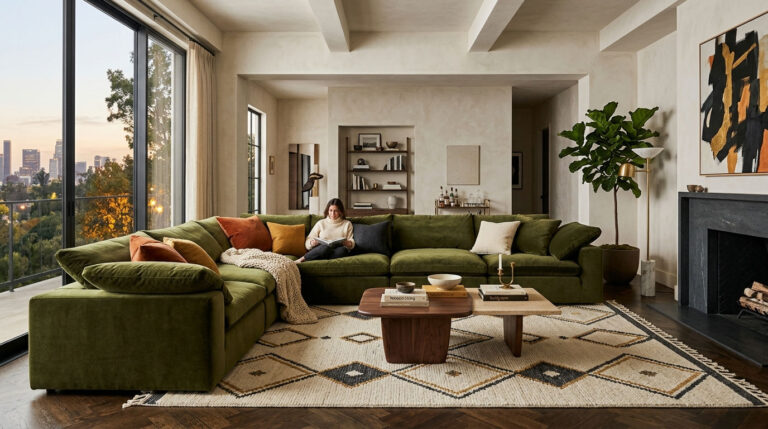
The most common sectional shape is the L-shape, where two runs of seating meet at a right angle. But sectionals also come in U-shapes, curved configurations, and fully modular arrangements that can be set up in virtually any layout the buyer chooses.
Sectional vs Regular Sofa: What Is the Difference?
The key difference is construction and configuration.
A regular sofa is a single, fixed piece of furniture. It comes in a set width, has a defined shape, and cannot be rearranged or reconfigured. It works well in most standard living rooms, but its size and shape are essentially predetermined.
A sectional sofa is made up of multiple joined sections. It is designed to cover more floor space, wrap around corners, and provide significantly more seating than a standard sofa. Because it is made in pieces, it can often be delivered more easily — sections go through doorways individually rather than as one large unit — and in some cases can be reconfigured if your room layout changes.
The practical upshot is that a sectional sofa offers more seating, a more distinctive layout, and greater adaptability, but it also takes up considerably more space and requires a larger room to look proportional.
Sectional vs Corner Sofa: Are They the Same Thing?
Essentially, yes — though the terminology differs by region.
In the United States and Canada, the term “sectional sofa” is standard. In the United Kingdom, Ireland, and much of Europe, the same type of furniture is most commonly called a “corner sofa.” Some retailers use both terms interchangeably.
The distinction, where one exists, is subtle. Some people use “corner sofa” to refer specifically to L-shaped configurations that use a corner piece, while “sectional” can refer to any multi-piece sofa arrangement including U-shapes and fully modular systems. But in everyday use, the two terms mean the same thing.
The Different Types of Sectional Sofas
Not all sectionals are the same. Understanding the different configurations will help you identify which type suits your room and lifestyle.
L-Shaped Sectional
The L-shaped sectional is the most common and widely available type. It consists of two runs of seating that meet at a right angle, forming an L shape when viewed from above.
One arm of the L is typically longer than the other, and the arrangement naturally fits into the corner of a room. The longer section often includes a chaise end — an extended footrest that allows one person to stretch out fully.
L-shaped sectionals work well in medium to large living rooms and are particularly effective in rooms where you want to define a seating zone without using walls as boundaries.
U-Shaped Sectional
A U-shaped sectional takes the L-shape a step further by adding a third run of seating, wrapping the sofa around three sides of a central open area. It is the largest standard sectional configuration and provides the most seating of any sofa type.
U-shaped sectionals require a genuinely large room to look proportional — typically at least 4.5 to 5 metres in one direction — but in the right space they create an extraordinary sense of enclosure, comfort, and social gathering. They are ideal for families who host frequently or for open-plan spaces where a large sofa helps define and anchor the living zone.
Curved Sectional
A curved sectional follows the same multi-section construction but uses curved pieces to create a gentle arc rather than sharp right angles. The result is a sofa that feels softer and more organic in form, often creating a more intimate conversation layout.
Curved sectionals work beautifully in large, open rooms where the organic shape provides visual contrast to straight-edged architecture. They are less common than L-shaped configurations and tend to be found in the mid-to-premium price range.
Modular Sectional
A modular sectional is the most flexible type of all. Rather than being sold as a fixed configuration, it is made up of completely interchangeable individual units — armless seats, corner pieces, ottomans, end units — that can be arranged in any layout the buyer chooses.
True modular sofas can be set up as an L-shape today and completely reorganised tomorrow. They can be split into separate seating arrangements for different rooms, expanded by purchasing additional units over time, and reconfigured whenever a move or a room layout change demands it.
Modular sectionals are particularly popular with renters and people who move frequently, as the sections can be carried through tight doorways individually and reassembled in the new space without limitation.
Chaise Sectional
A chaise sectional is the simplest form of sectional — essentially a standard sofa with an extended chaise longue section on one end. It is smaller than a full L-shaped sectional and works in rooms that are not quite large enough for a full corner configuration.
The chaise end allows one person to stretch out fully while the rest of the sofa functions as normal seating. It is a popular choice for people who want a little more relaxation space without committing to a full sectional footprint.
Left-Hand Facing vs Right-Hand Facing: What Does It Mean?
This is one of the most important — and most commonly misunderstood — details when buying a sectional sofa.
When a sectional is described as left-hand facing (LHF) or right-hand facing (RHF), it refers to the position of the longer section or chaise end when you are sitting on the sofa and facing outward.
- Left-hand facing means the chaise or longer arm extends to your left when you are seated on the sofa facing into the room.
- Right-hand facing means it extends to your right.
To work out which you need, stand in the position where the sofa will sit and face the room. Whichever side you want the longer section to extend toward is the configuration you need.
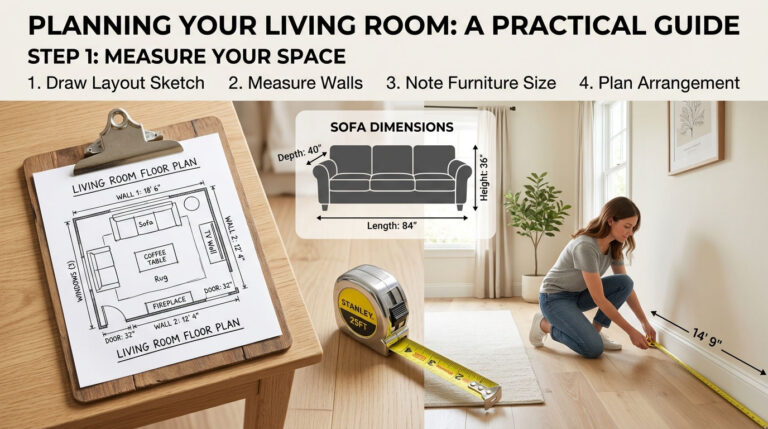
Getting this wrong is one of the most common — and most frustrating — sofa-buying mistakes. Always confirm LHF or RHF before ordering, and if you are in any doubt, sketch a simple floor plan of your room showing the sofa’s position and work it out with a diagram before placing your order.
What Are the Benefits of a Sectional Sofa?
Sectionals are enormously popular for a reason. Here are the main advantages they offer over a traditional sofa.
Maximum seating in one piece
A sectional sofa provides more seating than almost any single-piece sofa. An L-shaped sectional typically seats four to six people comfortably; a U-shaped configuration can seat six to eight or more. For families and frequent hosts, this is often the decisive factor.
Corner space efficiency
Corners are among the most underused areas in any living room. A sectional sofa turns that corner space into valuable, comfortable seating — using the room’s geometry to its advantage rather than leaving it empty.
Room definition in open-plan spaces
In open-plan homes where the living area flows into the kitchen or dining space, a sectional sofa provides a natural boundary. The L or U shape creates a defined living zone without the need for walls, partitions, or physical barriers. Positioning the back of the longer section to face the kitchen effectively separates the two areas while keeping the space open.
A natural conversation layout
The wrap-around shape of a sectional naturally encourages people to face each other, making it one of the best sofa configurations for conversation, socialising, and family gatherings.
Delivery in sections
Because a sectional is made up of multiple pieces, each section is smaller and easier to carry than a single large sofa. This makes navigating tight hallways, narrow staircases, and awkward doorways considerably more manageable on delivery day.
What Are the Drawbacks of a Sectional Sofa?
In fairness, sectionals are not the right choice for every home or every buyer. Here are the trade-offs worth considering.
They require significant space
A sectional sofa is large. In a small or medium living room, a full L-shaped sectional can overwhelm the space, block walkways, and make the room feel claustrophobic rather than comfortable. As a general guideline, a room should be at least 3.5 to 4 metres in both directions before an L-shaped sectional will sit comfortably.
They are harder to rearrange
Once a sectional is in place, moving it is a significant undertaking. The multiple sections, their weight, and the size of the overall footprint make repositioning the sofa a two-person job at minimum. If you like to regularly rearrange your living room, a sectional may frustrate that habit.
They can date the room
A very large sofa in a bold colour or distinctive style becomes the most dominant element in the room. If your taste changes or you want to refresh the decor, a sectional is harder to work around than a smaller, more neutral piece of furniture.
Gaps between sections can be an issue
On lower-quality sectionals, the joins between sections can shift, create gaps, or become unstable over time. This is particularly noticeable with modular configurations. Always check how the sections connect and whether the mechanism is secure before buying.
How to Choose the Right Sectional for Your Room
Measure thoroughly — and then measure again
The footprint of a sectional sofa is larger and more complex than a standard sofa, so accurate measurement is absolutely essential. You need to know:
- The full width and depth available for the sofa, including both arms of the L
- The clearance between the sofa and adjacent walls, furniture, and walkways — aim for a minimum of 75 to 90 cm
- The width and height of every doorway, hallway, and staircase the sections will need to navigate on delivery day
- Whether the corner piece will sit in an actual corner or be positioned in open space
Use masking tape to mark out the full footprint on your floor before ordering. This single step will save you from one of the most common and expensive sofa-buying mistakes.
Consider the room layout holistically
Think about where the TV is positioned, where the main light sources are, where people enter and exit the room, and how foot traffic flows through the space. The open end of the L-shape — the side without the chaise — typically becomes the natural entry point to the seating area. Position this where it makes the most sense for how people move through the room.
Choose the right configuration for your space
In most rooms, the choice between LHF and RHF is determined by the room layout rather than personal preference. Sketch the room and identify which configuration allows the chaise end to sit in a logical position — typically against a wall or in a corner — without blocking doorways or pathways.
Match the size to the room
As a rough guide:
| Room Size | Recommended Sectional |
|---|---|
| Under 20 m² | Chaise sectional or small L-shape (max 240 cm per arm) |
| 20–30 m² | Standard L-shaped sectional |
| 30–40 m² | Large L-shaped or small U-shaped |
| 40 m²+ | U-shaped or large modular configuration |
These are starting points rather than fixed rules. Always defer to your actual measurements over general guidelines.
What to Look for in a Quality Sectional Sofa
Frame construction
Look for a kiln-dried hardwood frame — beech and oak are the most common and most durable choices. Avoid sofas that do not specify frame materials, as this often indicates softwood or engineered wood construction that will not last as long.
Lift a corner of the sofa and observe how the frame responds. A well-constructed frame will lift as one rigid unit. Flexing or twisting indicates weak joinery.
Section connectors
The mechanism that holds sections together is particularly important in a sectional sofa. Look for metal brackets, sturdy hook-and-bar systems, or embedded fasteners. Avoid configurations that rely solely on weight and proximity to stay in place — these will shift during everyday use and create increasingly annoying gaps over time.
Suspension system
Sinuous springs (S-shaped zigzag springs running across the seat) are the standard at mid-range price points and provide good support and durability. Eight-way hand-tied coil springs represent the highest quality and are found in premium sectionals. Webbing is used in lower-cost options and tends to sag over time.
Cushion fill
High-density foam provides firm, long-lasting support that holds its shape reliably. Foam wrapped in a fibre layer adds a softer surface feel while retaining structural support. Feather and down filling is luxuriously soft but requires regular plumping. For a sectional that will see heavy everyday use, high-density foam or a foam and fibre combination is the most practical choice.
Fabric durability
Sectionals are large and heavily used, which means fabric wear is a real consideration. Performance fabrics — polyester blends or treated weaves engineered to resist stains and wear — are the most practical choice for family sectionals. For a more design-forward or adult-focused home, velvet, boucle, and linen are beautiful options, but they require more care and are less forgiving of heavy use.
Sectional Sofa Sizes: A Quick Guide
Sectional dimensions are more complex than standard sofa dimensions because you need to track measurements for each arm of the configuration.
| Configuration | Typical Arm Length | Total Depth at Corner |
|---|---|---|
| Small L-Shape | 200–240 cm × 140–160 cm | 130–150 cm |
| Standard L-Shape | 240–280 cm × 160–180 cm | 140–160 cm |
| Large L-Shape | 280–320 cm × 180–220 cm | 160–180 cm |
| U-Shape | 300–400 cm × 200–260 cm total | 200–260 cm |
The “total depth at corner” figure is the diagonal measurement of the corner section — this is the most critical figure for understanding how much floor space the sofa will occupy at its widest point.
Always request exact dimensions from the retailer for the specific sofa you are considering, as these vary significantly between manufacturers.
How to Style a Sectional Sofa
A sectional sofa will inevitably be the dominant piece in your living room, so styling it well matters.
Anchor it with a rug
A large rug is almost essential with a sectional. It visually anchors the sofa to the floor and prevents it from looking like it is floating in the space. As a rule, the rug should extend at least 30 to 40 cm beyond the sofa on each open side. All front legs of the sofa should sit on the rug.
Balance it with a substantial coffee table
A small coffee table in front of a large sectional will look lost. Choose a coffee table that is proportional to the length of the sofa’s main section — typically at least half the sofa’s length — and leave 40 to 50 cm of clear space between the table and the seat cushions.
Use cushions to add colour and texture
Because sectionals are so large, they offer a generous canvas for cushions. Group cushions in odd numbers — three or five — and vary the sizes, textures, and tones. A consistent colour palette with two or three complementary tones tends to look more intentional than a random mix.
Keep the rest of the room lighter
A large sectional carries significant visual weight. Balance it by keeping other furniture more streamlined and less imposing. Wall-mounted shelving rather than a bulky TV unit, slimmer armchairs rather than heavy club chairs, and a lighter colour palette on the walls will all help prevent the room from feeling overwhelmed by the sofa.
Common Sectional Sofa Buying Mistakes
Not measuring the room accurately. The most common and most preventable mistake. A sectional is large, its footprint is complex, and the margin for error is small. Measure every dimension carefully before ordering.
Confusing LHF and RHF. Ordering the wrong configuration means the sofa will face the wrong direction in the room. Draw a floor plan and confirm which orientation you need before placing the order.
Underestimating the depth. Many buyers focus on the arm lengths and overlook the depth of the corner section. The corner is the widest point of the sofa and it is the dimension that most frequently causes problems with room flow.
Ignoring delivery access. Each section of the sofa still needs to get through your front door, hallway, and into the living room. Measure every access point before buying.
Choosing style over structure. A poorly constructed sectional will shift, sag, and separate at the seams within a few years. Invest in quality frame construction and section connectors — these are the elements that determine longevity.
Buying too large for the room. A sectional that is too big will dominate the room completely, block natural pathways, and make the space feel cramped rather than comfortable. When in doubt, size down slightly.
Is a Sectional Sofa Right for You?
A sectional sofa is likely the right choice if:
- You have a living room that is at least 3.5 to 4 metres in both directions
- You regularly need seating for four or more people
- You have a corner space you want to use efficiently
- You have an open-plan living area that needs a seating zone defined
- You have children or a large household that puts heavy demands on seating
A sectional sofa is probably not the right choice if:
- Your living room is small or medium-sized
- You like to rearrange your furniture regularly
- You want the flexibility to update your decor frequently without the sofa becoming a constraint
- Your access routes — hallways, staircases, doorways — are particularly narrow
Final Thoughts
A sectional sofa is one of the most practical, generous, and layout-defining pieces of furniture you can bring into a living room. When it is the right size for the space, installed in the right configuration, and built with quality construction, it will serve a household exceptionally well for years.
The key is doing the groundwork before you buy. Measure your room precisely, understand the LHF and RHF distinction, confirm every access route for delivery, and invest in quality construction over eye-catching style alone.
Get those fundamentals right and you will end up with a sectional sofa that not only looks beautiful but genuinely transforms how your living room feels and functions every single day.

Sarah Rose writes for EcoGardeningHub, sharing eco home decor ideas, sustainable styling tips, and simple ways to create beautiful, nature-inspired living spaces with a mindful, environmentally friendly approach.