Sofa Sizes Explained: A Simple Guide to Finding the Perfect Fit for Any Room
Buying a sofa is one of the most important decisions you will make when furnishing your home. It anchors the living room, sets the tone for the entire space, and — if you get it wrong — can make even a beautiful room feel cramped, off-balance, or just plain awkward.
The good news? Choosing the right sofa size is not as complicated as it seems. Once you understand the standard dimensions, know how to measure your space properly, and learn a few golden rules about proportion and placement, you will be equipped to make a confident choice every single time.
This guide covers everything you need to know about sofa sizes — from standard widths and depths to specific room types and common mistakes to avoid.
Why Sofa Size Matters More Than You Think
Most people fall in love with a sofa’s style or fabric first, then worry about size later. This is where things go wrong.
A sofa that is too large will dominate the room, block pathways, and make the space feel suffocating. A sofa that is too small will look lost, leave awkward gaps, and fail to create the cosy, anchored feel that a living room needs.
Getting the size right means your sofa will:
- Allow comfortable traffic flow around the room
- Be in proportion with the other furniture
- Suit the number of people who regularly use the space
- Fit through your doorway, hallway, and staircase on delivery day
That last point is one many buyers overlook until it is too late.
Standard Sofa Dimensions: What the Numbers Mean
Before diving into specific sofa types, it helps to understand the three key measurements that define any sofa.
Width is the measurement from one armrest to the other. This is the most commonly referenced dimension and the one most people mean when they talk about sofa “size.”
Depth is the measurement from the very front of the seat cushion to the back of the sofa. This affects how the sofa fits in the room and how comfortable it feels to sit in. A deeper sofa feels more relaxed and loungy; a shallower one feels more upright and formal.
Height is the measurement from the floor to the top of the back cushions or the back frame. This matters for how the sofa looks against a wall or window, and for how it balances with other furniture in the room.
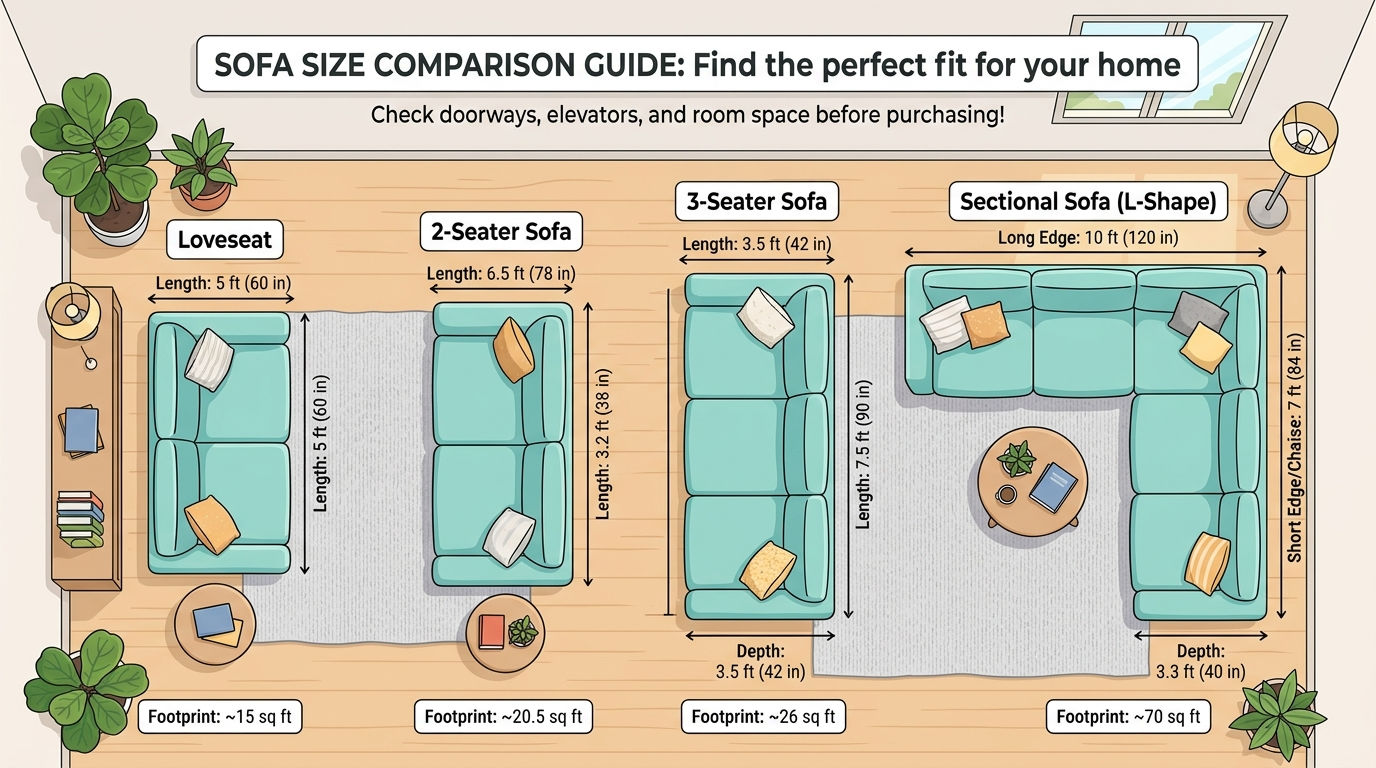
Here is a general overview of the measurements you can expect across different sofa types:
| Sofa Type | Width | Depth | Height |
|---|---|---|---|
| 2-Seater | 130–180 cm (51–71 in) | 75–95 cm (30–37 in) | 70–90 cm (28–35 in) |
| 3-Seater | 175–230 cm (69–91 in) | 80–100 cm (31–39 in) | 70–90 cm (28–35 in) |
| 4-Seater | 230–270 cm (91–106 in) | 85–100 cm (33–39 in) | 75–95 cm (30–37 in) |
| L-Shaped / Corner | 220–300 cm (87–118 in) per side | 140–170 cm (55–67 in) total | 70–90 cm (28–35 in) |
| Loveseat | 120–150 cm (47–59 in) | 70–90 cm (28–35 in) | 70–85 cm (28–33 in) |
| Chaise Lounge | 155–200 cm (61–79 in) | 80–100 cm (31–39 in) | 70–85 cm (28–33 in) |
These are general ranges. Dimensions vary between manufacturers and sofa styles, so always check the specific measurements for any sofa you are considering rather than assuming it will match the “standard.”
Types of Sofas and Their Typical Sizes
2-Seater Sofa
A 2-seater sofa typically measures between 130 cm and 180 cm wide. It comfortably seats two adults and is an excellent choice for smaller living rooms, home offices, bedrooms, or as a companion piece to a larger sofa in an open-plan space.
Despite being called a 2-seater, the actual comfort level depends on depth and cushion design as much as width. A generously deep 2-seater can feel roomier than a narrow 3-seater.
Best for: Small living rooms, apartments, second seating areas, home offices.
3-Seater Sofa
The 3-seater is the most popular sofa size and what most people picture when they think of a standard sofa. It typically ranges from 175 cm to 230 cm wide.
It works well in a wide range of living rooms and offers enough seating for a small family or a few guests without overwhelming the space. Many 3-seater sofas sit comfortably against the wall of a medium-sized living room without crowding the area.
Best for: Medium to large living rooms, family homes, open-plan spaces.
4-Seater Sofa
A 4-seater sofa usually falls between 230 cm and 270 cm in width. At this size, you are starting to need a genuinely spacious room to avoid the sofa dominating the space.
These are great for families who need generous seating or for larger rooms where a 3-seater would feel undersized and leave the space looking sparse.
Best for: Large living rooms, family homes, open-plan dining and living spaces.
Loveseat
A loveseat is a compact two-person sofa, typically between 120 cm and 150 cm wide. It is smaller than a standard 2-seater and is designed specifically for cosy, intimate seating.
Loveseats are ideal for rooms where space is at a real premium — small apartments, reading nooks, conservatories, or snug areas. They also work beautifully as a secondary seat paired with a larger sofa.
Best for: Small rooms, conservatories, reading corners, secondary seating.
L-Shaped / Corner Sofa
L-shaped sofas (also called corner sofas) are among the largest sofa configurations available. They typically span between 220 cm and 300 cm along each arm of the L-shape, and the total footprint varies significantly depending on the configuration.
Their key advantage is that they make excellent use of corner space — a part of the room that often goes underused. They also provide a generous amount of seating and create a natural, enclosed feeling that works well in open-plan spaces.
Because they are so large, corner sofas require careful measuring before purchase. The total depth across the corner section must be considered, not just the width of each arm.
Best for: Large living rooms, open-plan spaces, families who need maximum seating.
Chaise Lounge Sofa
A chaise lounge sofa is typically 155 cm to 200 cm long and includes an extended footrest section on one side. It blurs the line between a sofa and a day bed, offering a relaxed, luxurious seating option.
It is worth noting that when a sofa is described as having a “chaise” end, the total footprint is considerably larger than a standard sofa of the same seating capacity. Always measure the full length including the chaise section.
Best for: Large living rooms, bedrooms, reading areas, open-plan spaces.
How to Measure Your Room for a Sofa
Getting accurate measurements before you buy is non-negotiable. Here is how to do it properly.
Step 1: Measure the Room
Measure the full length and width of the room in centimetres. Note the position of windows, doors, radiators, and any built-in features like alcoves or fireplaces.
Step 2: Map Out the Seating Area
If your living room is open-plan or you use a rug to define the seating zone, measure that specific area rather than the entire room. The sofa should sit within this zone comfortably.
Step 3: Allow for Walkways
Leave a minimum of 75 cm to 90 cm of clear space between the sofa and any adjacent furniture, wall, or walkway. This is the minimum comfortable clearance for a person to walk through. In high-traffic areas, aim for 90 cm or more.
Step 4: Consider the Sofa’s Relationship to the TV
If your sofa faces a television, the ideal viewing distance is generally 1.5 to 2.5 times the diagonal screen size of the TV. So for a 55-inch TV, a comfortable viewing distance is roughly 200 cm to 350 cm. Make sure there is enough room between the sofa and the TV stand to land within this range.
Step 5: Use Masking Tape to Test the Size
Before ordering, use masking tape on the floor to mark out the exact footprint of the sofa you are considering. Live with those markings for a day or two. Walk around them, sit in the area, and observe how the space feels. This simple trick has saved many people from an expensive mistake.
The Rule of Proportions: How to Get the Scale Right
Even if a sofa technically “fits” in a room, it might still look wrong if the proportions are off. Here are the key proportional rules to keep in mind.
The two-thirds rule is the most widely used guideline in interior design. Your sofa should ideally take up no more than two-thirds of the wall it sits against. So if your wall is 360 cm wide, your sofa should be no wider than roughly 240 cm. This leaves breathing room on either side and prevents the room from feeling blocked.
Match the sofa to the rug. If you are using a rug to anchor the seating area, the sofa’s front legs — at minimum — should sit on the rug. A rug that is too small for the sofa will make both look out of place. As a general rule, the rug should extend at least 30 cm beyond the sofa on each side.
Balance with other furniture. A large sofa in a room filled with low, small furniture will look imposing. Try to match the visual weight of the sofa with the other pieces in the room. Pair a large sofa with a substantial coffee table, full-height shelving, or a statement armchair.
Sofa Sizes for Specific Room Types
Small Living Rooms
In a small living room, the temptation is to go for the smallest sofa available — but this is not always the right call. A sofa that is too small can make a room feel sparse and unresolved.
Instead, consider a compact 2-seater or loveseat, and position it carefully. Floating the sofa slightly away from the wall, rather than pushing it back against it, can actually make a small room feel larger. Pair it with a slim-profile coffee table and avoid bulky additional seating.
Aim for a sofa no wider than 180 cm in a small living room, and prioritise shallow depth to preserve floor space.
Medium Living Rooms
A medium living room — roughly 3.5 m by 4 m to 4 m by 5 m — is where a 3-seater sofa truly comes into its own. This is the sweet spot for most homes.
In this size of room, you can also consider an L-shaped sofa if the layout suits it, particularly if there is a corner that could be used efficiently.
Large Living Rooms and Open-Plan Spaces
In a large or open-plan living room, a standard 3-seater can look underwhelming. The room has the visual space to carry something larger.
Consider a 4-seater, a generous L-shaped sofa, or a U-shaped configuration. In open-plan spaces particularly, the sofa plays an important role in defining and separating the living zone from the dining or kitchen area. A larger sofa helps anchor the space and give it structure.
Apartments
Apartments present a specific challenge: you need maximum seating in minimum space, often with narrow hallways and tight stairwells to navigate on delivery day.
For apartments, focus on sofas with a modest depth (80 cm or less), as depth eats into floor space more aggressively than width. Look for modular sofas that can be delivered in sections, which makes getting them through a narrow entrance much more practical.
Do Not Forget the Delivery Dimensions
One of the most overlooked aspects of buying a sofa is whether it will actually fit through your home on delivery day.
Before you purchase, measure:
- The width and height of your front door
- The width of your hallway
- The turning radius at the bottom of any staircase or landing
- The width and height of your living room door
The critical measurement for most sofas is the diagonal depth — the distance from one corner of the sofa to the opposite corner when tilted at an angle. This is often larger than the sofa’s standard depth measurement, and it is what matters when navigating tight doorways and turns.
Many retailers offer a “white glove” delivery service where the delivery team will assess access in advance. If you live in a flat above the first floor or have a particularly narrow hallway, it is worth contacting the retailer before purchasing to confirm delivery is feasible.
Common Sofa Sizing Mistakes (and How to Avoid Them)
Buying without measuring. It sounds obvious, but a surprising number of people buy a sofa based on how it looks in the showroom without ever measuring their room. Always measure first.
Ignoring the depth. Width gets all the attention, but depth has just as much impact on how a sofa fits in a room. A sofa that is 100 cm deep takes up significantly more floor space than one that is 85 cm deep, even if the width is identical.
Forgetting the coffee table gap. If you plan to have a coffee table in front of the sofa, you need to account for that space too. Leave a minimum of 40 cm to 50 cm between the sofa and the table for comfortable legroom.
Choosing style over function. A beautiful curved sofa in a small rectangular room will create dead space on either side and make the room feel chaotic. Prioritise fit first, then find the most stylish option within those constraints.
Not considering the doorway. As mentioned above, the delivery route matters as much as the room dimensions. Measure every tight point between your front door and the living room before you buy.
Quick Reference: Sofa Size by Room Size
| Room Size | Recommended Sofa |
|---|---|
| Up to 12 m² | Loveseat or compact 2-seater (max 150 cm wide) |
| 12–20 m² | 2-seater or small 3-seater (150–200 cm wide) |
| 20–30 m² | 3-seater or medium L-shaped (200–250 cm wide) |
| 30–40 m² | 4-seater or large L-shaped (250–300 cm wide) |
| 40 m²+ | Large L-shaped, U-shaped, or sectional configuration |
Final Thoughts
Finding the perfect sofa size is not about following a single formula — it is about understanding your room, your lifestyle, and the specific dimensions of the sofa you are considering, then making sure all three align.
Take your time, measure carefully, use the masking tape trick, and do not let yourself get so swept up in aesthetics that you skip the practical steps. A sofa that fits beautifully in your room — one that leaves space to move, suits the scale of the other furniture, and comfortably seats everyone who needs it — will always look better than a sofa that is technically beautiful but practically wrong.
Get the size right first. Everything else will follow.

Sarah Rose writes for EcoGardeningHub, sharing eco home decor ideas, sustainable styling tips, and simple ways to create beautiful, nature-inspired living spaces with a mindful, environmentally friendly approach.