What Is the Best Sofa for a Small Living Room? A Practical Guide
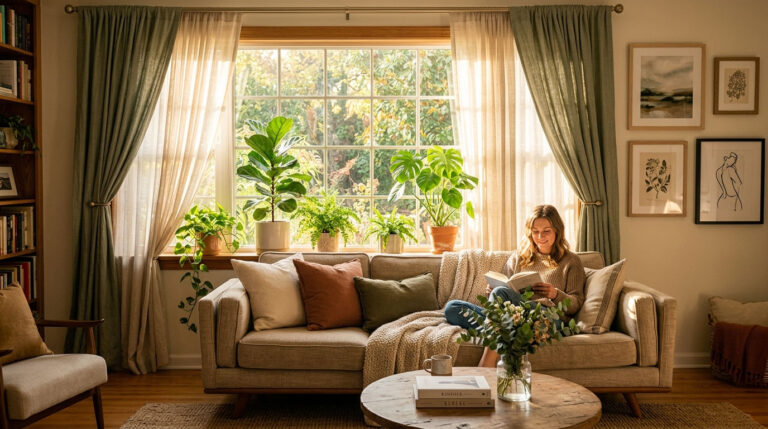
Small living rooms present one of the most common — and most solvable — challenges in home design. The sofa is usually the centrepiece of the space, and in a compact room, the wrong choice doesn’t just look bad. It makes the entire room feel smaller, heavier, and harder to live in. The right choice, on the other hand, can make a small living room feel surprisingly spacious, functional, and even elegant.
The good news is that choosing a sofa for a small living room isn’t about settling for less. It’s about choosing smarter — understanding which dimensions, styles, colours, and configurations work with limited space rather than against it. Done well, a small living room with a thoughtfully chosen sofa can feel more considered and more intentional than a larger room that simply absorbed whatever furniture came its way.
This guide covers everything you need: the ideal sofa dimensions for small spaces, the styles and configurations that work best, the colours and fabrics that open a room up, and the layout strategies that maximise every square foot. By the end, you’ll know exactly what to look for — and what to avoid — when choosing a sofa for a compact living room.
Why Getting This Right Matters More in Small Spaces
In a large living room, a slightly oversized sofa is an inconvenience. In a small living room, it’s a disaster. It blocks walkways, dominates the entire room visually, and makes the space feel claustrophobic rather than cosy. The margins for error are simply much smaller.
At the same time, undershooting — buying a sofa that’s too small — creates its own problems. A tiny loveseat in a room that could comfortably take a standard three-seater looks forlorn and out of scale, and wastes the opportunity to seat people comfortably.
The goal is precision: a sofa that fits the room’s proportions exactly, leaves adequate clearance for traffic flow, and performs every function you need — without dominating or disappearing.
Step One: Know Your Numbers
Before you look at a single sofa, you need two sets of numbers: the dimensions of your room and the dimensions of the space your sofa can realistically occupy.
Measure the Room
Measure your room’s length and width at their longest and widest points. Note the position of all doorways, windows, radiators, and any built-in features. These features constrain where the sofa can go and how large it can be.
Calculate the Available Sofa Space
Apply the clearance rules that interior designers use for small spaces:
- Between the sofa and coffee table: 14 to 18 inches (35 to 45 cm) — enough to reach the table comfortably without it feeling like a hazard
- Main walkways around the sofa: 30 to 36 inches (75 to 90 cm) minimum — anything narrower and people will be squeezing past each other
- Between sofa and TV: based on your screen size — roughly 7 to 9 feet (210 to 275 cm) for a standard 55-inch screen
- Between sofa back and wall: 2 to 3 inches (5 to 8 cm) is fine; many small-room sofas are pushed closer or flush against the wall
Subtract all these clearances from the room’s total dimensions. What remains is your maximum sofa footprint — the width and depth the sofa can occupy without compromising how the room functions.
Write these numbers down. They are your hard limits. Any sofa that exceeds them is the wrong sofa, regardless of how much you love it.
The Two-Thirds Rule
As a proportional guide: your sofa should occupy roughly two-thirds of the wall it sits against — no more. This leaves visual breathing room on either side and prevents the sofa from feeling like it was shoehorned into the space. In a small room with a 10-foot (300 cm) wall, this suggests a sofa no wider than approximately 6.5 to 7 feet (195 to 210 cm).
The Best Sofa Styles for Small Living Rooms
Once you know your dimensions, the next question is style. Not all sofa designs work equally well in small spaces. The following styles are consistently the most effective.
1. The Two-Seater (Loveseat)
Best for: Very small rooms, studio flats, rooms that are primarily functional rather than social
A two-seater sofa — typically 51 to 67 inches (130 to 170 cm) wide — is the obvious starting point for compact spaces. It provides comfortable seating for two without dominating the room, and leaves the maximum floor space free for other furniture and movement.
The risk with a loveseat is going too small. In a room that could take a modest three-seater, choosing a loveseat purely out of caution can make the room feel under-furnished and the sofa look lost. Always verify your maximum sofa width before defaulting to the smallest option.
2. The Apartment Sofa (Compact Three-Seater)
Best for: Most small living rooms — the most versatile option
The apartment sofa — sometimes called a compact or small-scale sofa — is a standard three-seater designed with a smaller footprint. Typically 70 to 80 inches (178 to 203 cm) wide rather than the standard 84 to 90 inches (213 to 229 cm), these sofas seat three people comfortably while taking up meaningfully less floor space.
This is the sweet spot for most small living rooms. It provides full seating capacity, works with standard furniture arrangements, and is available across a wide range of styles and price points. If you’re unsure what size to buy for a small room, start here.
Look for apartment sofas with shallower seat depths (20 to 22 inches / 51 to 56 cm rather than the standard 24 to 26 inches / 61 to 66 cm) — this is often where the most significant floor space saving is made.
3. The Chaise Sofa (One-Arm Chaise)
Best for: Rooms where one wall is significantly longer than the other; people who want to lie down on the sofa
A chaise sofa — a three-seater with a chaise extension on one end — sounds counterintuitive for a small room. But used correctly, a chaise can actually work better than a separate sofa-and-armchair combination because it provides more seating in a single footprint, eliminating the need for additional pieces.
The key is placement: the chaise should run along the longer wall or into a corner where it doesn’t obstruct walkways. The arm-free end of the chaise can often sit closer to a wall than a sofa with two full arms, saving additional space.
Choose a small-scale chaise (overall width of 90 to 100 inches / 228 to 254 cm) rather than a full-sized version, and look for models with a shallow overall depth.
4. The Small Corner Sofa (Compact L-Shape)
Best for: Square rooms; households that need maximum seating; rooms where the sofa is the only major seating piece
Corner sofas have a reputation for being large — and full-sized L-shapes certainly are. But compact corner sofas, designed specifically for smaller spaces, can be surprisingly effective. They nestle into a corner, using space that would otherwise be wasted, and provide seating along two walls rather than one.
The benefits in a small room: maximum seating capacity in a single piece, no need for additional chairs, and a cosy, enclosed feel that works well in compact spaces.
What to watch for: the overall dimensions of both arms. A corner sofa with arms measuring 80 inches (203 cm) each will require a room with at least 10 feet (300 cm) along both walls to work comfortably with clearances. Measure very carefully before committing.
Look for compact corner sofas with arms of 70 to 80 inches (178 to 203 cm) and a shallow seat depth — these are genuinely manageable in rooms of modest size.
5. The Sofa Bed
Best for: Rooms that need to multitask — particularly guest rooms or studio flats
A sofa bed is an excellent choice for small spaces where the living room sometimes doubles as a bedroom. Modern sofa beds — particularly those with pull-out frames and proper mattresses rather than the fold-over futon style — are significantly more comfortable than their reputation suggests.
For small rooms, look for sofa beds with a relatively contained footprint when closed: a two-seater or compact three-seater profile. When shopping, always test the sofa in both configurations — the seating should be comfortable for daily use, and the bed mechanism should open fully without requiring the sofa to be moved away from the wall (many designs require 3 to 4 feet of clearance in front).
What to Avoid in a Small Living Room
Knowing what not to buy is as important as knowing what to look for. These are the most common small-room sofa mistakes:
Deep Seat Sofas
Seat depth is the single most impactful dimension in a small room — and the one most frequently overlooked. A sofa with a seat depth of 26 inches (66 cm) projects 4 to 6 inches further into the room than one with a 20-inch (51 cm) depth. In a small room, that difference is enormous.
Always check the overall depth (front to back measurement, including cushions) of any sofa you’re considering. For small rooms, aim for a maximum overall depth of 34 to 36 inches (86 to 91 cm). Any deeper and it will eat disproportionately into your floor space.
High Backs
High-backed sofas — those with back cushions rising 36 inches (91 cm) or more from the floor — create a visual barrier that makes small rooms feel divided and enclosed in an uncomfortable way. They also prevent light from flowing freely through the space.
Low and mid-back sofas (back cushion height of 28 to 34 inches / 71 to 86 cm from the floor) keep sight lines open, allow light to travel more freely, and make the room feel larger and more connected.
Overstuffed, Boxy Styles
Sofas with very thick, rounded arms and deep, heavily padded cushions have a visual mass that’s out of proportion in small rooms. Every inch of visual bulk counts. Sleeker, more streamlined designs with thinner arms and a more defined silhouette take up less visual space even when the physical dimensions are similar.
Full-Sized Sectionals
A full-sized sectional in a small living room is almost always a mistake. The sheer footprint of a standard sectional — typically 110 inches (279 cm) or more along both arms — overwhelms a compact space and leaves little room for anything else. If you love the look and feel of a sectional, opt for a compact corner sofa instead (see above).
Dark, Heavy Colours on Large Sofas
A large sofa in a dark, heavy colour visually dominates a small room and advances toward you, making the space feel smaller. This doesn’t mean you can’t have colour or pattern — but it does mean being thoughtful about how it’s applied.
Colours and Fabrics That Work in Small Spaces
Colour and material choice significantly affects how a sofa reads in a room — and by extension, how large or small the room feels.
Light and Medium Tones Open a Room Up
Light-coloured sofas — cream, warm white, soft grey, natural linen, pale blush — reflect light back into the room rather than absorbing it. This creates a sense of airiness and openness that darker colours undermine. In a small room with limited natural light, a light-toned sofa can make a meaningful difference to how bright and spacious the space feels.
Medium tones — dusty blue, sage green, warm terracotta, camel — also work well in small rooms, provided the walls are light and the room has adequate light. These colours add personality without the visual weight of deep, saturated hues.
Match or Tone Closely with the Walls
One of the most effective tricks for making a sofa feel less dominant in a small room is to choose a sofa colour that closely matches or tones with the wall colour. When the sofa and walls are in the same colour family, the eye doesn’t register the sofa as a separate, advancing element — it reads as part of the room rather than an object sitting in it. This can make a sofa feel significantly less imposing than a strongly contrasting colour would.
Avoid Very Busy Patterns at Scale
Bold, large-scale patterns — dramatic florals, wide geometric repeats — on sofas in small rooms tend to overwhelm the space. The pattern has nowhere to breathe and can feel relentless. If you love pattern, choose a smaller scale or a more subtle repeat, or confine it to cushions against a solid sofa.
Consider the Leg Reveal
The material and height of the sofa’s legs affects how heavy it feels in the room. Sofas with visible legs — particularly tapered wooden or metal legs — allow the floor to be seen beneath the sofa, which creates a visual impression of more floor space and a lighter overall form. Sofas that sit directly on the floor or on a heavy plinth hide the floor entirely and can feel more imposing.
In small rooms, prefer sofas with visible legs of at least 4 to 6 inches (10 to 15 cm). The difference in perceived visual weight is surprisingly significant.
Layout Strategies for Small Living Rooms
Even the right sofa in the right size will feel wrong if it’s not positioned correctly. Layout matters enormously in a small room.
Push the Sofa Against the Wall — But Not Always
The instinct in a small room is to push all the furniture against the walls to “free up” the centre of the room. With the sofa, this often does work — it maximises floor space in front and creates a clear zone for movement. But it’s not always the only option.
Floating the sofa slightly away from the wall — even just 4 to 6 inches (10 to 15 cm) — can make a room feel less rigid and more designed. It creates a subtle sense of depth behind the sofa and can make the space feel less boxed-in. If you have the room to spare, it’s worth experimenting with.
Use the Sofa to Define Zones in Open Plans
In an open-plan space that incorporates a small living area, the back of the sofa can act as a visual and physical divider between the living zone and the adjacent kitchen or dining area. Position the sofa with its back to the kitchen or dining space, facing the TV wall, and it creates a clear zone without walls — making the living area feel defined and purposeful rather than undefined and cramped.
Pair with Armless or Slim-Profile Chairs
If you need additional seating beyond the sofa, avoid large armchairs in small rooms — they take up nearly as much space as a two-seater sofa. Instead, look for:
- Armless accent chairs — their slim profile takes up less visual and physical space
- Slipper chairs — low, compact, and visually light
- Folding or stackable chairs — stored out of sight and brought out only when needed
- Ottomans — multifunctional pieces that serve as footrests, coffee tables, or extra seating
Choose the Right Coffee Table
The coffee table in front of a sofa in a small room deserves careful thought. A large, solid coffee table takes up disproportionate floor space. Alternatives that work better:
- Round coffee tables — softer edges mean they’re easier to navigate around in tight spaces
- Nesting tables — can be spread out when needed and stacked when not
- Glass-topped tables — visually disappear, taking up no visual space while still performing their function
- Ottomans with trays — double as seating, footrests, and surfaces; no hard corners to navigate around
Keep the space between the sofa and coffee table at the minimum comfortable clearance (14 to 16 inches / 35 to 40 cm) rather than pushing it further away, which wastes space in front of the sofa without benefit.
Use Vertical Space Above the Sofa
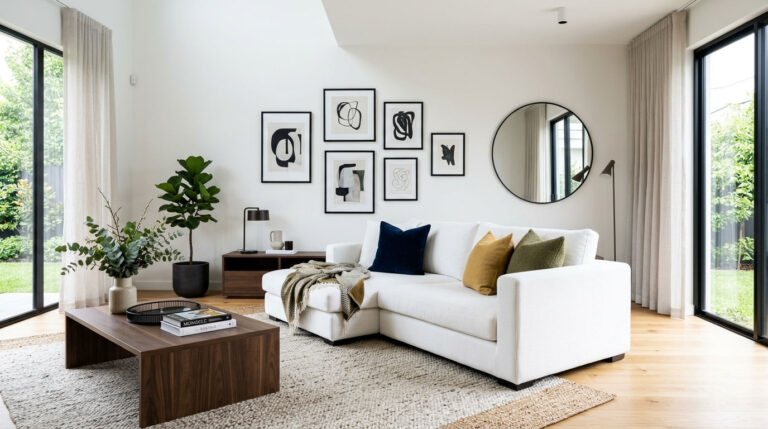
In a small room, the wall above the sofa is prime real estate. A gallery wall, a large mirror, or a single oversized piece of art above the sofa draws the eye upward and creates a sense of height that counteracts the room’s limited floor area. This is one of the most effective ways to make a small room feel larger — and it costs nothing in floor space.
A large mirror above or adjacent to the sofa is particularly effective: it reflects light and the room back on itself, creating a visual impression of depth and space that is genuinely transformative.
The Best Sofa Features to Prioritise in Small Rooms
When comparing specific sofas for a small living room, prioritise these features above all others:
Shallow seat depth (20 to 22 inches / 51 to 56 cm seat depth; 32 to 36 inches / 81 to 91 cm overall depth) — the biggest space-saver available
Slim or tapered arms — narrow arms save 2 to 4 inches on each side compared to thick, padded arms; that’s up to 8 inches of overall width saved without losing any seating
Visible legs (4 inches / 10 cm or taller) — creates visual lightness and a sense of more floor space
Low to mid back height (28 to 34 inches / 71 to 86 cm from floor to top of back cushion) — keeps sight lines open and the room feeling connected
Light or medium colour — reflects light, reduces visual mass, and makes the sofa feel less imposing in the space
Modular design — some sofas can be configured differently over time or adapted as your space changes; this is a useful feature if your living situation is likely to evolve
Quick Sofa Size Guide for Small Living Rooms
Use this as a reference when shopping:
| Room Width | Recommended Max Sofa Width | Best Sofa Type |
|---|---|---|
| Under 10 ft / 300 cm | Up to 60 in / 152 cm | Two-seater / loveseat |
| 10–12 ft / 300–365 cm | Up to 72 in / 183 cm | Compact three-seater / apartment sofa |
| 12–14 ft / 365–425 cm | Up to 84 in / 213 cm | Standard three-seater or small chaise |
| 14–16 ft / 425–490 cm | Up to 96 in / 244 cm | Small corner sofa or larger three-seater |
Remember: these are maximum widths based on the two-thirds wall rule. Always subtract clearances before using these figures as buying targets.
Final Thoughts
The best sofa for a small living room isn’t necessarily the smallest sofa available — it’s the one that fits the room’s proportions precisely, leaves adequate clearance for comfortable movement, and performs the functions you actually need without dominating the space.
The key decisions, in order of importance: get the dimensions right first, then choose a style with a slim profile and visible legs, then select a light or medium colour that works with your walls and light levels. Apply those three principles consistently and you’ll find a sofa that makes your small living room feel larger, more comfortable, and more considered than you thought possible.
Small rooms reward precision. Take the time to measure carefully, choose thoughtfully, and the space will surprise you with how much it can hold.

Sarah Rose writes for EcoGardeningHub, sharing eco home decor ideas, sustainable styling tips, and simple ways to create beautiful, nature-inspired living spaces with a mindful, environmentally friendly approach.