What Are the Different Types of Sofas? A Beginner’s Overview
Walk into any furniture store and the sheer number of sofas on display can feel overwhelming. Sectionals, chesterfields, loveseats, chaise lounges, sleeper sofas — the terminology alone is enough to make your head spin before you have even thought about colour or fabric.
But here is the thing: once you understand what each type of sofa is actually designed to do, the whole process becomes far simpler. Every sofa style exists for a reason. Each one solves a specific problem, suits a particular lifestyle, or fits a certain kind of room. When you know what you are looking at, you can cut through the noise and zero in on what is right for you.
This guide breaks down every major sofa type — what it looks like, how it works, who it suits, and what to consider before buying. Whether you are furnishing your first flat or reimagining a family living room, this is the starting point you need.
How Sofas Are Categorised
Sofas can be grouped in a few different ways — by their shape, by their seating capacity, by their frame style, or by a specific design they are named after. In practice, most people encounter sofas described by a combination of these factors.
For clarity, this guide is organised into three broad categories:
- By shape and configuration — how the sofa is physically arranged
- By frame and design style — the aesthetic and structural character of the sofa
- By function — sofas designed to do more than just seat people
Understanding which category a sofa belongs to will help you evaluate it more clearly when you are browsing.
Part One: Sofas by Shape and Configuration
Standard Sofa (3-Seater)
The standard sofa is what most people picture when they hear the word “sofa.” It is a straight, rectangular seat with a back and two arms, designed to seat three adults comfortably. Width typically ranges from 175 cm to 230 cm.
This is the most versatile sofa type available. It works in almost any living room, pairs well with armchairs and other seating, and comes in virtually every style, fabric, and colour imaginable. If you are unsure where to start, a classic 3-seater is always a safe and sensible anchor for a room.
Best for: Most living rooms, families, people who want maximum flexibility in styling.
Watch out for: The term “3-seater” does not guarantee the same amount of space across all sofas. Always check the actual width and seat depth before buying.
2-Seater Sofa
A 2-seater sofa follows the same structure as a standard sofa but is scaled down to seat two people. It typically ranges from 130 cm to 180 cm wide.
It is a practical choice for smaller rooms, but it also works beautifully as a companion piece in a larger room alongside a 3-seater or armchairs. Placing two 2-seater sofas facing each other is a classic and elegant living room arrangement.
Best for: Small living rooms, apartments, second seating areas, reading rooms.
Watch out for: Some 2-seaters are so compact that two adults sitting side by side feel cramped. Check the seat width per person, not just the overall sofa width.
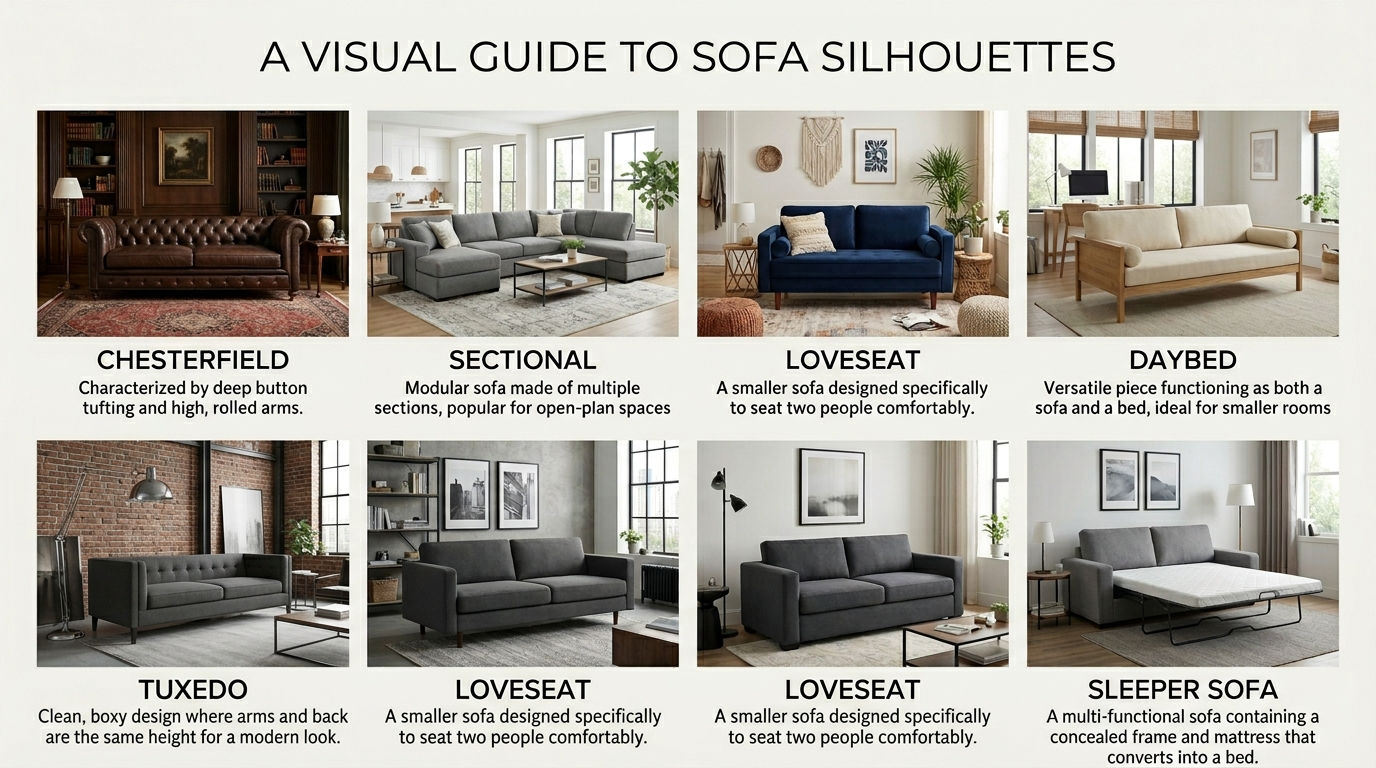
Loveseat
A loveseat is the smallest member of the standard sofa family. Typically 120 cm to 150 cm wide, it is designed for two people sitting close together — hence the name.
Loveseats are more intimate than a standard 2-seater and are often used in spaces where a full sofa would be too large: conservatories, snug areas, reading nooks, master bedrooms, or home offices. They also make excellent accent pieces in larger living rooms.
Best for: Small spaces, conservatories, bedrooms, accent seating in large rooms.
Watch out for: Loveseats can look out of scale if used as the sole seating in a medium or large living room.
Sectional Sofa (L-Shaped / Corner Sofa)
A sectional sofa is made up of multiple individual sections that connect together to form a larger seating configuration. The most common form is the L-shape, where two sections meet at a right angle to create a corner piece.
Sectionals are among the most practical sofas available for families. They offer generous seating, define a room’s layout naturally, and make excellent use of corner space that would otherwise go unused.
Most sectionals come in two configurations:
- Left-hand facing (LHF) — the chaise or longer section extends to the left when you are sitting on it
- Right-hand facing (RHF) — the chaise or longer section extends to the right
Always confirm which configuration you need before ordering, and check that the total footprint fits your room from corner to tip.
Best for: Large living rooms, open-plan spaces, families needing maximum seating.
Watch out for: Sectionals are large and can be difficult to reposition. Confirm delivery access through hallways and doorways before purchasing.
U-Shaped Sofa
A U-shaped sofa takes the sectional concept further by adding a third section, creating a sofa that wraps around three sides of a central area. It is the largest standard sofa configuration available.
U-shaped sofas are exceptional for creating a cosy, enclosed feel in very large rooms. They are also ideal for families who regularly host guests and need a significant amount of seating in one place.
The trade-off is size. A U-shaped sofa requires a genuinely large room — typically at least 5 metres wide — to look proportional and leave adequate circulation space.
Best for: Very large living rooms, open-plan spaces, families who host frequently.
Watch out for: The sheer scale. Measure the room thoroughly before committing, and use the masking tape method to map out the footprint first.
Modular Sofa
A modular sofa is made up of individual seat units — typically armless chairs, corner pieces, and end units — that can be arranged in any configuration the owner chooses. Unlike a standard sectional, which is designed in a fixed shape, a modular sofa is truly flexible.
You can arrange modular units into an L-shape today and reorganise them into two separate sofas tomorrow if your layout changes. They are also easier to move and deliver, since each piece goes through the door independently.
Modular sofas are a growing trend precisely because of this adaptability. They suit people who move frequently, rent their homes, or simply like the freedom to change their living room layout over time.
Best for: Renters, people who move frequently, anyone who wants long-term flexibility.
Watch out for: The connectors between sections vary in quality. Cheaper modular sofas may shift and separate over time — invest in a model with secure joining mechanisms.
Chaise Lounge Sofa
A chaise lounge is a sofa with an extended footrest on one end, allowing the sitter to stretch out their legs fully. The name comes from the French for “long chair,” which describes its elongated silhouette perfectly.
In its standalone form, a chaise lounge is an elegant, sculptural piece of furniture with a distinctly luxurious feel. As part of a sofa (often referred to as a “sofa with chaise”), the chaise extension adds a relaxed, loungy quality to one end of the seating.
The key consideration with a chaise sofa is whether the extension will be on the left or right side of the sofa, and which direction makes the most sense given your room layout.
Best for: Large living rooms, bedrooms, open-plan spaces, people who value comfort above all else.
Watch out for: The total length including the chaise extension is significantly greater than the seating section alone. Always measure the full piece.
Part Two: Sofas by Frame and Design Style
Chesterfield Sofa
The Chesterfield is one of the most iconic sofa designs in existence and has been in production since the 18th century. Its defining features are the deep button tufting across the back and seat cushions, the rolled arms that sit at the same height as the back, and the traditionally low-slung silhouette.
Originally associated with leather upholstery in rich dark colours, the Chesterfield has been reimagined countless times in velvet, linen, and boucle, and in every colour from classic oxblood red to contemporary sage green.
A Chesterfield brings an immediate sense of heritage, luxury, and personality to a room. It works equally well in a traditional setting and in a modern interior where it serves as a bold statement piece.
Best for: Traditional, maximalist, eclectic, or heritage-inspired interiors. Also works as a statement piece in contemporary rooms.
Watch out for: The tufting can be uncomfortable for some people, particularly on firmer leather versions. Sit in it before buying if possible.
Tuxedo Sofa
A tuxedo sofa is defined by its sharp, geometric lines. The back and arms are all the same height, creating a perfectly rectangular silhouette. The result is a crisp, tailored look that is more architectural than cosy.
Tuxedo sofas have been associated with mid-century modern design since their popularisation in the 1960s and 1970s, and they continue to feel contemporary and refined. They work particularly well in rooms with clean lines, minimal clutter, and a considered, modern aesthetic.
Best for: Modern, minimalist, mid-century, and contemporary interiors.
Watch out for: The high arms can feel restrictive compared to lower-armed styles. If you like to lounge sideways across a sofa, a tuxedo design may not be the most comfortable choice.
Camelback Sofa
A camelback sofa is recognisable by its curved back, which features one or more humps (much like a camel’s silhouette). This distinctive shape gives it an immediately traditional, formal character.
Camelback sofas are rooted in 18th-century English furniture design — Hepplewhite and Chippendale are among the designers associated with the style. They are elegant, structured, and best suited to more formal or classic interiors. They are not a typical choice for casual family living, but in the right room they are genuinely beautiful.
Best for: Traditional, formal, Georgian, and classic-inspired interiors.
Watch out for: The curved back is not to everyone’s taste and can limit versatility. This is very much a considered, characterful choice rather than a neutral one.
Mid-Century Modern Sofa
Mid-century modern sofas take their cues from the design movement of the 1950s and 1960s. They are characterised by clean lines, tapered wooden legs, low profiles, and a restrained, functional aesthetic. Cushions tend to be firm, upholstery tends to be flat rather than tufted, and the overall silhouette is sleek and sculptural.
This style has seen a significant revival in recent years and remains one of the most popular sofa aesthetics available. It suits both genuinely retro interiors and modern homes where the warmth of wood and the simplicity of the design complement contemporary decor.
Best for: Mid-century, Scandinavian, contemporary, and eclectic interiors.
Watch out for: The low profile means they sit closer to the floor, which some people find harder to get in and out of — something worth considering for older family members or those with mobility considerations.
Lawson Sofa
The Lawson sofa is the quintessential comfortable, relaxed sofa. Named after Thomas W. Lawson, an American financier who reportedly commissioned a more comfortable sofa in the early 20th century, it is characterised by its cushioned, padded arms that sit lower than the back, its loose back cushions, and its generally soft, sink-in feel.
Most sofas sold today in the mid-market are essentially variations of the Lawson style. It is the default of the sofa world — informal, approachable, and easy to live with.
Best for: Casual family living rooms, relaxed interiors, anyone prioritising comfort.
Watch out for: The very comfort that makes a Lawson sofa appealing can mean it ages less gracefully than firmer designs, with cushions flattening over time.
Bridgewater Sofa
A Bridgewater sofa is similar to the Lawson in its relaxed character but has a few distinguishing features: the arms are slightly lower and further set back, the back cushions tend to be larger and more generous, and the overall silhouette is softer and more rounded.
If the Lawson sofa is casual and easy, the Bridgewater takes that a step further into genuinely plush, enveloping comfort. It is a sofa that you sink into rather than sit on.
Best for: Traditional, cottage, country-house, and relaxed family interiors.
Watch out for: The generous proportions mean Bridgewater sofas tend to be quite deep. Measure your room carefully and consider whether the depth works for your space.
Togo Sofa
The Togo is a design icon. Designed by Michel Ducaroy for Ligne Roset in 1973, it is a low-slung, legless sofa with a deeply quilted, rippled form that is unlike anything else in furniture design. It sits directly on the floor, is filled with foam, and is famous for its almost boneless, sculptural quality.
The Togo is not a traditional sofa — it is a design statement. It suits open-plan spaces, creative interiors, and homes where furniture is chosen as much for its visual impact as its function.
Best for: Contemporary, eclectic, maximalist, and design-forward interiors.
Watch out for: Its low height and lack of legs makes it harder to get up from than a standard sofa, particularly for those with back or knee issues.
Canapé Sofa
A canapé (from the French) refers to a small, elegant sofa — often antique or antique-inspired — with an exposed wooden frame, upholstered seat and back, and a distinctly refined, decorative character. It sits somewhere between a sofa and a settee.
Canapés are more decorative than functional. They are the kind of piece you find in a formal sitting room, entrance hallway, or bedroom — adding elegance and period character rather than casual seating.
Best for: Traditional, French-inspired, maximalist, and formal interiors.
Watch out for: They are typically not designed for everyday comfort or heavy use. Treat them as a design accent rather than primary seating.
Part Three: Sofas by Function
Sofa Bed (Sleeper Sofa)
A sofa bed is a sofa that conceals a fold-out mattress within its frame, transforming it into a bed when needed. It is the classic solution for guest rooms and small spaces where a dedicated spare bed is not possible.
Sofa beds come in a wide range of quality levels. The cheapest versions have thin, uncomfortable mattresses and flimsy frames. The best versions are genuinely good to sleep on and barely distinguishable from a regular sofa when folded up. The quality of the mattress — its thickness, material, and support — is the single most important factor when choosing a sofa bed.
Common mechanisms include pull-out mattresses (most common), click-clack fold-flat designs (simpler and more compact), and futon-style fold-downs.
Best for: Guest rooms, studio apartments, small homes where a dedicated guest room is not possible.
Watch out for: Do not compromise on mattress quality. A thin, spring-loaded mattress will make your guests uncomfortable and will likely put them off staying again.
Sofa Cum Bed (Day Bed Style)
A sofa cum bed is similar to a sofa bed but often simpler in its mechanism. It typically converts by removing back cushions and pulling the seat section flat, or by adjusting the back to a horizontal position. It does not always have a separate mattress — the cushions themselves form the sleeping surface.
This style is common in Indian and Southeast Asian interiors and is popular in smaller homes where multi-functional furniture is essential.
Best for: Small homes, multi-use rooms, studio and one-bedroom apartments.
Watch out for: The sleeping surface is often less comfortable than a dedicated sofa bed mattress. Best suited to occasional use rather than regular overnight sleeping.
Recliner Sofa
A recliner sofa allows individual seats to recline backward, extending a footrest from the front of the seat. Some models recline manually with a lever mechanism; others use an electric motor controlled by a button.
Recliner sofas prioritise physical comfort above all else. They are enormously popular with people who spend long periods of time on the sofa — watching television, reading, or relaxing after long days on their feet.
Aesthetically, recliners have a reputation for being bulky and ungainly, but this has improved considerably in recent years. Many contemporary recliner sofas have a much more streamlined appearance than older models, though they still tend to be deeper and heavier than non-reclining equivalents.
Best for: Home cinema rooms, family living rooms, anyone prioritising physical comfort over aesthetics.
Watch out for: Recliner sofas need clearance behind them to recline fully — typically 30 cm to 45 cm from the wall. Do not push them against a wall without checking the reclining mechanism first.
Corner Sofa Bed
A corner sofa bed combines the spaciousness of an L-shaped sectional with the functionality of a sofa bed. The chaise section typically converts into the sleeping surface, making it an efficient use of space.
This is an increasingly popular choice for smaller apartments where the living room also needs to double as a guest room.
Best for: Apartments, open-plan spaces, homes that regularly accommodate overnight guests.
Watch out for: The conversion mechanism can be complex on some models. Check how easy it is to convert before buying — ideally, test it in person in the showroom.
Armless Sofa (Settee)
An armless sofa has no arms at all, giving it a clean, minimal silhouette. It takes up less visual and physical space than an armed sofa, which makes it useful in rooms where space is limited or where a less imposing look is desired.
Armless sofas are common in contemporary and minimalist interiors and are often used in combination with other seating — for example, as a bench-like piece alongside armchairs.
Best for: Minimalist interiors, small rooms, secondary seating alongside armchairs.
Watch out for: The absence of arms means less support when sitting. If you like to lean against a sofa arm or use it as a headrest when lying down, an armless design may not suit you.
How to Choose the Right Sofa Type for You
With so many options available, narrowing down your choice can feel daunting. These four questions will help you focus quickly.
How much space do you have? Your room size is the first and most important filter. Measure your space carefully before looking at sofas. This alone will eliminate many options that simply will not fit.
How do you use your living room? A family with young children needs something durable, easy to clean, and generously sized. A couple in a compact flat needs something space-efficient and versatile. A person who works from home may want something more formal and structured. Let your lifestyle drive the choice.
What is your aesthetic? Some sofa types are strongly associated with particular interior styles. A Chesterfield will always suggest heritage and formality. A Togo will always suggest contemporary design-consciousness. A modular will always suggest modern flexibility. Choose a sofa that feels consistent with the room you are building.
Do you need additional functionality? If you regularly have guests to stay, a sofa bed is worth serious consideration. If you have limited storage or a multi-use room, a modular sofa offers long-term adaptability. Function should be part of the decision from the very beginning.
A Quick Reference Guide to Sofa Types
| Sofa Type | Best For | Key Feature |
|---|---|---|
| Standard 3-Seater | Most living rooms | Maximum versatility |
| 2-Seater | Small rooms, secondary seating | Compact and flexible |
| Loveseat | Very small spaces, accent seating | Intimate scale |
| Sectional / Corner | Large rooms, families | Corner efficiency, generous seating |
| U-Shaped | Very large rooms, frequent hosts | Maximum seating capacity |
| Modular | Renters, flexible lifestyles | Completely reconfigurable |
| Chaise Lounge | Relaxed, spacious rooms | Extended footrest |
| Chesterfield | Traditional, formal interiors | Button tufting, rolled arms |
| Tuxedo | Modern, minimal interiors | Geometric, architectural lines |
| Mid-Century Modern | Contemporary, Scandinavian interiors | Tapered legs, low profile |
| Lawson | Casual family living | Comfortable, relaxed, padded |
| Sofa Bed | Guest rooms, small homes | Concealed fold-out mattress |
| Recliner | Home cinema, comfort-first rooms | Reclining seats with footrest |
| Armless | Minimalist, small spaces | Clean lines, less visual weight |
Final Thoughts
The world of sofas is genuinely varied, and that variety exists because there is no single perfect sofa for everyone. The right sofa for you depends on your room, your lifestyle, your aesthetic, and what you need your sofa to do.
Use this guide as a reference point rather than a definitive rulebook. Start by identifying which category of sofa suits your practical needs — the right size, the right function. Then move into style and design. When those two things align, you will find yourself looking at a much shorter, more manageable list of options.
And once you know what type of sofa you are looking for, everything else — the colour, the fabric, the finishing details — becomes a far more enjoyable decision to make.

Sarah Rose writes for EcoGardeningHub, sharing eco home decor ideas, sustainable styling tips, and simple ways to create beautiful, nature-inspired living spaces with a mindful, environmentally friendly approach.