How to Store Clothes in a Small Bedroom Without a Closet (Complete Guide)
Living in a small bedroom without a closet can feel like a constant battle against clutter. Whether you’re in a studio apartment, an older home built before built-in closets were standard, or a rented room with zero storage, the challenge is real — but absolutely solvable.
The good news? You don’t need a closet to have an organized, stylish wardrobe. With the right strategies, furniture, and a little creativity, you can store all your clothes efficiently while actually making your bedroom look better in the process.
This guide covers every practical solution — from budget-friendly DIY hacks to investment furniture pieces — so you can find what works best for your space and lifestyle.
Why Closet-Free Bedrooms Are More Common Than You Think
Before diving into solutions, it helps to understand why so many bedrooms lack closets. Older homes built before the mid-20th century rarely had built-in closets — wardrobes and armoires were the standard storage furniture of the era. Many city apartments, especially in converted buildings or older neighborhoods across South Asia, Europe, and beyond, were simply never designed with closet space in mind.
Understanding this means embracing the idea that external storage solutions are not a compromise — they’re a legitimate, often more flexible and stylish alternative.
Step 1: Declutter Before You Organize
This is non-negotiable. Trying to organize too many clothes in a small space is a losing battle. Before you invest in any storage solution, ruthlessly edit your wardrobe.
Ask yourself for each item:
- Have I worn this in the last 12 months?
- Does it fit me right now?
- Is it damaged, faded, or something I genuinely dislike?
A smaller, curated wardrobe stored well will always beat a massive wardrobe stored poorly. Donate, sell, or pack away off-season items before you start organizing your active clothing collection.
Step 2: Use a Freestanding Wardrobe or Armoire
A freestanding wardrobe is the most direct replacement for a built-in closet. It gives you hanging space, shelves, and sometimes drawers — all in one unit.
What to Look For
- Height: Go as tall as your ceiling allows. Taller wardrobes maximize vertical space and feel less bulky than wide, short ones.
- Depth: Standard depth is around 50–60 cm (20–24 inches). Avoid going deeper than necessary — it eats into your floor space.
- Doors: Sliding doors are ideal for small rooms since they don’t swing outward and consume floor space.
- Interior configuration: Look for a mix of hanging rail, shelves, and a drawer or two for folded items and accessories.
Best Placement
Place the wardrobe along the longest wall of your bedroom or in a recessed alcove if you have one. Painting it the same color as the wall behind it creates a seamless, built-in look even without carpentry.
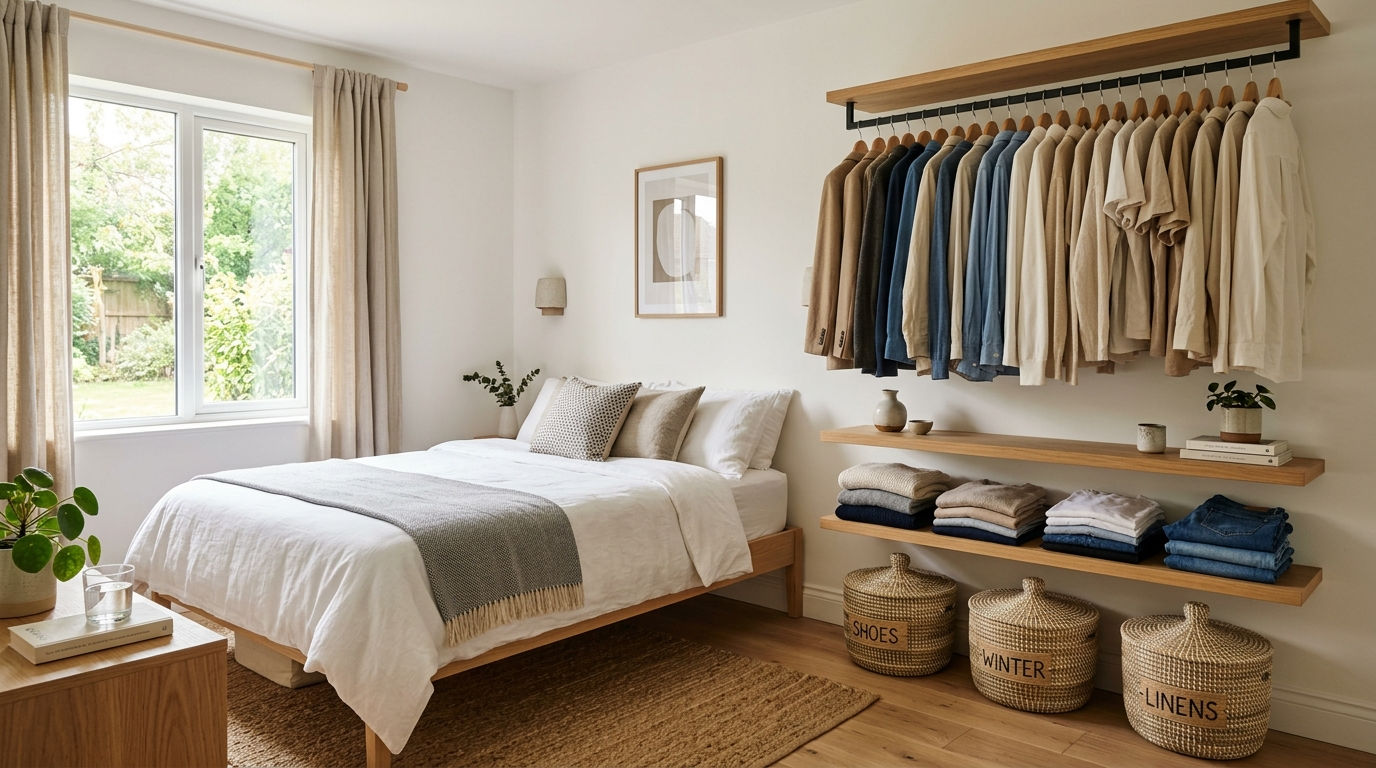
Step 3: Install a Clothing Rack or Open Rail System
Open clothing racks have become genuinely stylish in modern bedroom aesthetics. They’re affordable, easy to assemble, and incredibly flexible.
Types of Clothing Racks
Single-rail racks are the most minimal and budget-friendly. They work well if you have a small collection of hang-worthy pieces.
Double-rail racks give you twice the hanging capacity in the same footprint — perfect for separating tops from bottoms or organizing by season.
Industrial pipe racks (mounted to the wall or freestanding) are more permanent but extremely sturdy. They can hold heavier items like coats and denim jackets without bending.
Corner racks slot into a room corner, making excellent use of otherwise dead space.
How to Make Open Racks Work Visually
Open storage requires a bit more discipline since everything is visible. A few tips:
- Organize clothes by color for an instantly curated, boutique-style look.
- Keep only the current season’s hanging items on the rack; store off-season clothes elsewhere.
- Use matching slim velvet hangers — they save space and make everything look more cohesive.
- Add a small shelf unit or woven basket underneath the rack for shoes or folded extras.
Step 4: Maximize Under-Bed Storage
The space under your bed is some of the most underused real estate in a small bedroom. Depending on your bed height, you could have significant storage capacity right at your feet.
Best Under-Bed Storage Solutions
Flat rolling bins: These shallow plastic or fabric bins roll in and out easily and are ideal for seasonal clothing, extra bedding, or shoes. Look for ones with lids to keep dust out.
Vacuum storage bags: Perfect for bulky items like winter sweaters, duvets, and jackets. They compress items dramatically and lay completely flat under the bed.
Under-bed drawers: Some bed frames come with built-in drawers. If yours doesn’t, you can buy drawer units specifically designed to slide under standard-height beds.
Storage ottomans or platform beds with lift-up storage: If you’re buying a new bed, consider a hydraulic lift storage bed — the entire mattress lifts to reveal a cavernous storage space beneath.
Maximizing Vertical Clearance
If your current bed sits low to the ground, bed risers can increase clearance by 15–20 cm (6–8 inches), dramatically increasing the volume of what fits underneath.
Step 5: Add a Chest of Drawers or Dresser
A well-chosen chest of drawers can hold a surprising volume of clothing — far more than most people realize — when items are folded efficiently.
The KonMari Folding Method
Marie Kondo’s vertical folding technique is transformative for drawer storage. Instead of stacking clothes flat (where you only access the top item and forget what’s underneath), fold each piece into a small rectangle and stand it upright in the drawer like a file. You can see every item at a glance and the drawer holds significantly more.
This method works especially well for:
- T-shirts and tops
- Jeans and trousers
- Underwear and socks
- Casual knitwear
Choosing the Right Dresser
For small rooms, a tall narrow chest of drawers is usually better than a wide, low dresser. It has a smaller footprint while offering the same or greater storage capacity. A 5–6 drawer tall chest is ideal.
Step 6: Use Wall Space Creatively
Walls are vertical real estate that most people in small bedrooms completely ignore for clothing storage.
Wall-Mounted Hooks and Pegboards
A row of sturdy hooks mounted at shoulder height can hold bags, belts, hats, scarves, and tomorrow’s outfit. Pegboards (made popular by workshop organization) are incredibly versatile — you can reconfigure hooks and shelves as your needs change.
Place hooks near the bedroom door for easy-access everyday items. Use deeper hooks or S-hooks for heavier bags and coats.
Floating Shelves for Folded Items
A series of floating shelves installed above a clothing rack or dresser can hold:
- Neatly folded jeans or sweaters
- Shoe boxes or bins
- Baskets for accessories
- Decorative items that double as storage (hat stacks, jewelry dishes)
Keep the shelves at a reachable height and avoid overloading them — the goal is accessible, not cluttered.
Step 7: Optimize a Corner with a Corner Wardrobe or Shelving Unit
Corners are notoriously wasted in small bedrooms. A corner shelving unit, corner wardrobe, or even a tension rod strung diagonally across a corner can create a dedicated clothing nook out of nothing.
Some people go further and build a simple DIY corner closet using:
- Two tension rods at different heights (short rack for tops, lower rack for folded items hung over a hanger)
- A curtain rod with ceiling-to-floor curtains to hide the corner “closet”
- A small shelf unit placed in front of the corner for additional folded storage
The curtain trick is particularly effective — it gives the illusion of a built-in wardrobe while keeping your entire wardrobe accessible and hidden from view.
Step 8: Store Shoes Smartly
Shoes are one of the biggest contributors to bedroom clutter when there’s no closet. Dedicating a specific solution to shoes alone keeps the rest of your storage tidier.
Shoe Storage Options for Small Bedrooms
Over-the-door shoe organizers: These hang on the back of your bedroom door and can hold 12–24 pairs without using any floor space. Some versions have deeper pockets suitable for sneakers and flats.
Stackable clear shoe boxes: These stack neatly, protect shoes from dust, and let you see exactly what’s inside without opening anything. They’re especially satisfying if you have a collection worth displaying.
Shoe benches: A bench at the foot of the bed with shoe storage inside serves a dual purpose — seating and storage. Great for frequently worn shoes.
Under-shelf shoe racks: If you have a clothing rack with a bottom shelf, a small angled shoe rack underneath is an efficient use of that space.
Step 9: Use the Back of Every Door
Every door in your bedroom is a storage opportunity. Beyond shoe organizers, consider:
- Over-door accessory organizers for belts, scarves, ties, and jewelry
- Over-door hooks for bags, robes, and next-day outfits
- Slim pocket organizers for small accessories, receipts, or sunglasses
The back of a wardrobe door (if you have a freestanding unit) can hold ties, belts, and accessories on small hooks or a rack mounted inside.
Step 10: Rotate Seasonal Clothing
One of the most powerful strategies for making a small storage system work year-round is seasonal rotation. You only need immediate access to clothes appropriate for the current season — everything else can be stored out of the way.
How to Rotate Seasonally
- At the start of each season, pack away the previous season’s clothing in:
- Vacuum storage bags (for bulky knitwear and coats)
- Flat bins stored under the bed or on high shelves
- A suitcase stored under the bed or in another room
- Wash or dry clean everything before storing it — stains set over months and attract insects.
- Use cedar blocks or lavender sachets to deter moths.
- Label each storage bag or bin clearly so you know exactly what’s inside.
This rotation alone can effectively cut your active wardrobe storage needs in half.
Step 11: Use Luggage and Bags as Storage
If you have suitcases, duffel bags, or large tote bags stored somewhere in your home, put them to work. Suitcases stored under the bed can be filled with off-season clothes, spare linens, or anything you don’t need regular access to.
This eliminates the “dead storage” problem of a suitcase taking up space while contributing nothing to your home’s organization.
Step 12: Consider a Room Divider with Storage
If your bedroom is large enough to benefit from zoning, a bookcase or shelving unit used as a room divider can double as clothing storage on one side and decor or books on the other.
IKEA’s KALLAX shelving unit (or similar open cube shelves) works particularly well for this — it can stand perpendicular to a wall to create a partition, with baskets and bins holding folded clothes on the bedroom side.
Top Tips for Keeping a Closet-Free Bedroom Organized Long-Term
Getting organized is one thing — staying organized requires a few ongoing habits:
Adopt a “one in, one out” rule. Every time something new enters your wardrobe, something old leaves. This prevents gradual accumulation from undoing your organization.
Do a 15-minute reset weekly. Return items to their proper place, rehang anything that’s slipped, and tidy surfaces. Preventing pile-ups is far easier than tackling them once they’ve grown.
Be honest about your habits. If you always end up with a “chair pile” of worn-but-not-dirty clothes, dedicate a specific hook or basket to that category instead of fighting it.
Reassess every season. When you rotate clothing, take stock of what you actually wore. Anything untouched is a candidate for removal.
Budget-Friendly vs. Investment Solutions: A Quick Guide
Under $50 (Budget):
- Velvet hangers to maximize existing rack space
- Over-door shoe organizer
- Under-bed flat storage bins
- Vacuum storage bags for seasonal items
- Pegboard with hooks
$50–$200 (Mid-Range):
- Freestanding double-rail clothing rack
- Tall narrow chest of drawers (secondhand)
- Floating wall shelves
- Stackable clear shoe boxes
- Fabric wardrobe (pop-up zip-up style)
$200+ (Investment):
- Solid wood freestanding wardrobe
- Platform bed with built-in storage drawers
- Custom wall-mounted rail and shelf system
- Quality tall chest of drawers (new)
You don’t need to spend a lot to solve a storage problem. Many of the most effective solutions — rotating seasons, folding vertically, maximizing under-bed space, and using door backs — cost almost nothing.
Final Thoughts
A bedroom without a closet isn’t a design flaw — it’s an invitation to be more intentional about how you store and interact with your wardrobe. With the right combination of freestanding wardrobes, open clothing racks, under-bed storage, wall hooks, and smart folding techniques, you can create a system that’s more functional, more visible, and often more attractive than a conventional closet.
The key is to start with less (declutter first), go vertical where possible, rotate seasonally, and choose solutions that match both your space and your daily habits. A small bedroom without a closet, done right, can feel genuinely more organized than a larger room with a walk-in that’s never properly managed.
Start with one or two solutions that address your biggest pain points and build from there. Organization is a practice, not a destination — and in a small space, even small improvements make a big difference.

Sarah Rose writes for EcoGardeningHub, sharing eco home decor ideas, sustainable styling tips, and simple ways to create beautiful, nature-inspired living spaces with a mindful, environmentally friendly approach.