How to Turn a Garage Into a Legal Bedroom on a Budget (Complete Guide)
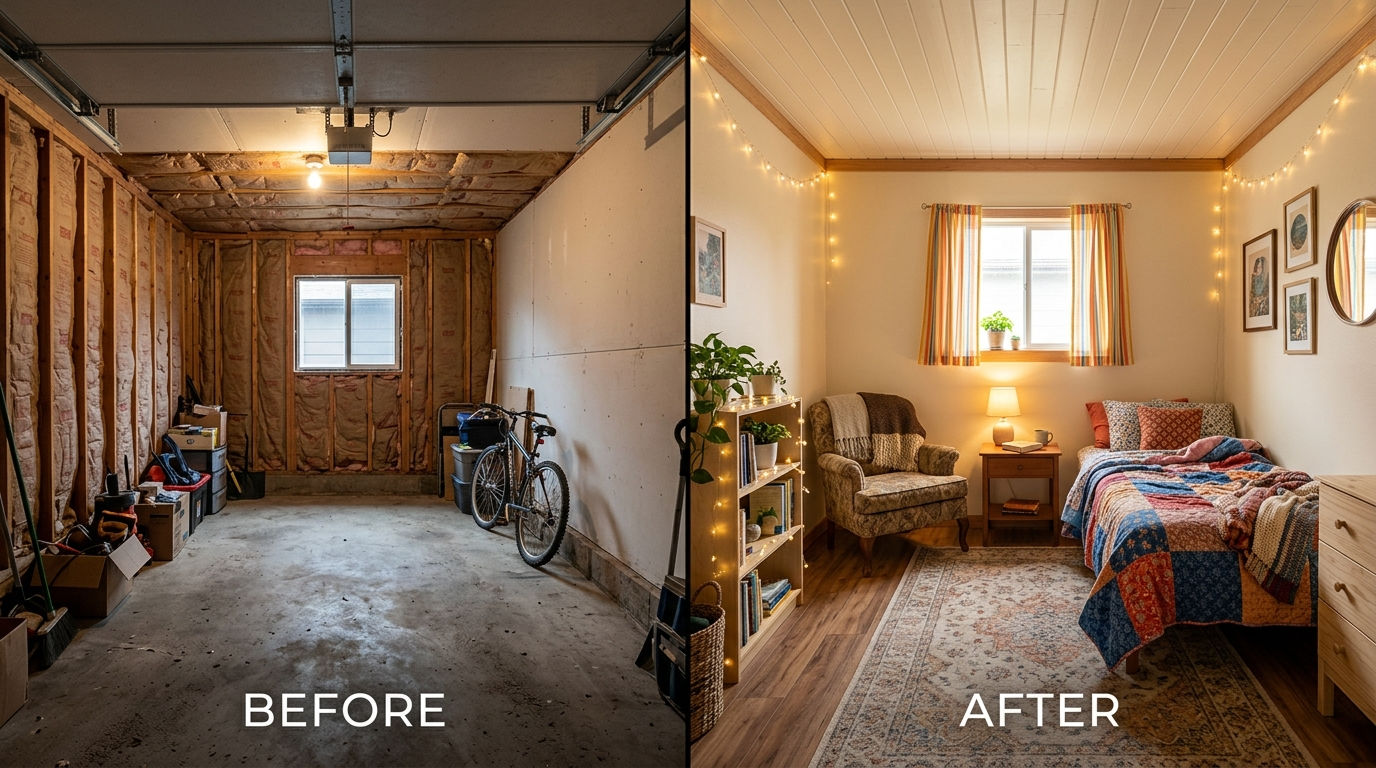
Converting your garage into a legal bedroom is one of the smartest ways to add living space and boost your home’s value — without the cost of a full addition. Whether you’re looking to house a growing family, create a rental unit, or add an in-law suite, a garage conversion can deliver a functional, code-compliant bedroom for a fraction of what new construction would cost.
But here’s the critical part: legal matters. A bedroom conversion that doesn’t meet local building codes won’t pass inspection, can’t be listed as a bedroom when you sell, and could even create liability issues. This guide walks you through every step — from permits to insulation to finishing touches — so you can do it right without breaking the bank.
What Makes a Bedroom “Legal”? Understanding Building Code Requirements
Before you swing a hammer, you need to know what your local building department requires. While codes vary by city and state, most jurisdictions follow the International Residential Code (IRC), which sets the baseline standards for habitable rooms.
Minimum Requirements for a Legal Bedroom
Here are the typical requirements a converted garage must meet to be classified as a legal bedroom:
- Minimum square footage: Usually 70–120 sq ft of floor space, with no dimension less than 7 feet
- Ceiling height: At least 7 feet of clear headroom (some codes require 7 ft 6 in)
- Egress window: A window that allows emergency escape — typically at least 5.7 sq ft of openable area, minimum 24 inches high and 20 inches wide, with the sill no higher than 44 inches from the floor
- Natural light: Window area equal to at least 8% of the floor area
- Ventilation: Openable window area of at least 4% of floor area, or mechanical ventilation
- Heating and cooling: The room must be connected to the home’s HVAC system or have its own climate control
- Smoke and carbon monoxide detectors: Required by virtually every jurisdiction
- Electrical outlets: Must meet current NEC standards — typically outlets every 12 feet along walls, and GFCI protection near any sink
Pro Tip: Always call your local building department before starting. Ask specifically about ADU (Accessory Dwelling Unit) rules if you plan to rent the space. Some cities have relaxed garage conversion rules to address housing shortages.
Step 1: Pull the Right Permits (Don’t Skip This)
This is the step most DIYers want to skip — and the one that causes the most problems down the road. Converting a garage without a permit means:
- The room can’t legally be counted as a bedroom in your home’s listing
- You may face fines or be required to demolish the work
- Home insurance may not cover incidents in an unpermitted space
- It complicates or kills a future home sale
How to Get a Garage Conversion Permit
- Visit or call your local building department (city or county level)
- Submit a site plan and floor plan showing the proposed layout, window placement, and structural changes
- Pay the permit fee — typically $100–$500 for a residential conversion
- Schedule required inspections (usually framing, electrical, insulation, and final)
Some jurisdictions have a streamlined “over-the-counter” permit for simple conversions that can be approved same-day. Others require plan review, which can take 2–6 weeks.
Budget estimate for permits: $150–$600
Step 2: Assess Your Garage’s Starting Point
Not all garages are created equal. Before you budget, do a thorough assessment:
What to Look For
- Slab condition: Cracks, moisture seeping up from below, or uneven concrete will need addressing before flooring goes in
- Ceiling height: Measure at the lowest point. If you have a sloped ceiling near the garage door, that area may not count toward your minimum headroom requirement
- Existing insulation: Most garages have none — budget for full wall, ceiling, and floor insulation
- Electrical panel capacity: Can your existing panel handle additional circuits? An older 100-amp panel in a home with a garage conversion may need an upgrade
- Plumbing proximity: If you want a closet bathroom, how close are existing water lines?
- Wall construction: Is the garage framed with wood studs, or are walls CMU (concrete block)? Block walls require a different insulation and finishing approach
Step 3: Handle Moisture and Weatherproofing First
Garages are not built to the same weatherproofing standard as living space. Moisture is your biggest enemy, and it must be addressed before any finishes go in.
Concrete Slab Moisture Control
Concrete slabs are porous. Without a moisture barrier, you’ll get condensation, mold, and ruined flooring.
Budget-friendly solutions:
- Vapor barrier + sleepers: Lay 6-mil polyethylene sheeting on the slab, then install 2×4 “sleeper” boards on top to create an air gap before subflooring ($1–$2/sq ft in materials)
- DRIcore subfloor panels: Engineered subfloor panels with a built-in moisture barrier on the bottom — faster and cleaner than sleepers (~$2.50–$3.50/sq ft)
- Epoxy vapor barrier coating: A two-part epoxy sealer painted directly on the slab creates a solid moisture barrier (~$0.50–$1.50/sq ft)
Wall and Ceiling Weatherproofing
- Seal all gaps around the top plate, bottom plate, and any penetrations with spray foam or caulk
- If the garage shares a wall with the outdoors (most do), that wall must be treated as an exterior wall with appropriate weather-resistant barrier behind the cladding
Budget estimate for moisture control: $300–$1,200 depending on slab size and method
Step 4: Insulate Thoroughly — This Is Non-Negotiable
Proper insulation is what separates a livable bedroom from a sweltering box in summer and a freezer in winter. It also impacts your energy bills and will be inspected before your drywall goes up.
Where You Need Insulation
Walls (exterior):
- Standard 2×4 framing: R-13 to R-15 fiberglass batts (~$0.40–$0.60/sq ft)
- For better performance in extreme climates: add 1-inch rigid foam board over the studs before drywall for R-18+ total
Ceiling / Roof:
- If there’s a living space above: R-19 to R-30 batts between joists
- If it’s an exposed roof deck (flat or sloped): rigid foam or spray foam is your best option — this is where costs climb
Floor:
- Rigid foam between sleepers achieves R-10 to R-15 and is the most cost-effective floor insulation approach
Garage door wall:
- Once the garage door is removed and framed in, treat this wall like any exterior wall
Dealing With the Garage Door Opening
You have two main options:
Option A — Frame in the opening entirely: Remove the door and header, frame a new wall with a window (required for egress and light), and insulate like any exterior wall. This gives you the most energy-efficient result and maximizes interior space.
Option B — Keep the garage door and insulate it: This works if you want to preserve the option to use the space as a garage again, or if local rules don’t require eliminating the door. Insulated replacement panels and a good door seal can help, but this is never as energy-efficient as a framed wall.
For a legal bedroom, Option A is almost always required, as you need to install a proper egress window.
Budget estimate for insulation: $500–$2,000 (DIY)
Step 5: Frame New Walls and Install the Egress Window
If your garage has any unfinished stud bays, or if you’re framing the former garage door opening, this is where the space starts to look like a room.
Framing the Garage Door Opening
- Remove the garage door, springs, tracks, and opener
- Temporarily support the header if needed
- Frame a new wall using 2×4 or 2×6 studs, 16 inches on center
- Rough-in the window opening per your egress window dimensions
- Install a proper header above the window opening (size depends on span and load)
Egress Window Installation
This is a code requirement and a budget priority. Don’t cut corners here — the window must:
- Meet minimum openable area (5.7 sq ft is common)
- Be reachable from the floor (sill no higher than 44 inches)
- Open fully without tools or keys
Budget-friendly egress window options:
- Vinyl double-hung or casement windows: $150–$400 per window installed DIY
- Slider windows (common in garage conversions because the opening is wide): $200–$500
Budget estimate for framing and egress window: $400–$1,500 (DIY labor)
Step 6: Run Electrical (Hire a Licensed Electrician)
This is the one area where DIY is risky and often illegal without a license, depending on your state. Electrical work in a new habitable room requires:
- Dedicated circuits for outlets and lighting
- AFCI (Arc Fault Circuit Interrupter) protection on bedroom circuits — required by NEC 2014 and later
- Proper outlet placement per NEC (every 12 feet along walls, within 6 feet of any door)
- Smoke detector wired into your home’s existing smoke alarm circuit (or battery if no interconnected system)
Keeping Electrical Costs Down
- Get three quotes from licensed electricians — prices vary widely
- Do the conduit and junction box rough-in yourself in jurisdictions that allow homeowner rough-in, then have the electrician do the final connections and panel work
- If your panel is at capacity, a subpanel in the garage ($300–$600 for materials) is cheaper than a full panel upgrade
Budget estimate for electrical: $800–$2,500 (depending on existing wiring proximity and scope)
Step 7: Add Heating and Cooling
The bedroom must be habitable year-round, which means a code-compliant HVAC solution.
Options From Least to Most Expensive
Extend existing ductwork: If your home’s furnace has capacity, extending ducts into the converted garage is cleanest. A single supply and return run can cost $500–$1,500 installed, depending on distance.
Mini-split heat pump (best budget-to-performance ratio): A single-zone ductless mini-split heats and cools with high efficiency. DIY-friendly “pre-charged” systems (like MRCOOL DIY) run $700–$1,200 for equipment, and installation is a reasonable weekend project for a handy homeowner. Requires a dedicated electrical circuit.
Electric baseboard heat + window AC: The cheapest upfront option ($200–$400 total), but the most expensive to operate. Good as a temporary solution or in mild climates.
Budget estimate for HVAC: $700–$2,500
Step 8: Install Drywall, Flooring, and Finishes
Once rough-in inspections are passed, you can close up the walls and start making the space feel like a real room.
Drywall
- Use 5/8-inch Type X drywall on any wall shared with an attached garage or the main house — this is a fire separation requirement in most codes
- Standard 1/2-inch drywall everywhere else
- Hire a drywall finisher if you can — tape and mud is the skill with the longest learning curve in home improvement
Budget estimate for drywall: $400–$1,200 materials + $600–$1,500 labor (or DIY)
Flooring Options on a Budget
| Option | Cost per sq ft (installed) | Best For |
|---|---|---|
| Luxury Vinyl Plank (LVP) | $2–$5 | Most garages — waterproof, durable, warm underfoot |
| Laminate | $1.50–$4 | Dry climates with good vapor barrier |
| Carpet | $2–$5 | Comfort priority; avoid if any moisture risk |
| Polished/stained concrete | $1–$3 | Modern aesthetic; cold underfoot without radiant heat |
LVP is the clear winner for most garage conversions — it’s waterproof, handles minor moisture vapor, installs as a floating floor (no adhesive), and looks great.
Paint, Trim, and Closet
- Paint: $50–$150 in materials for a standard bedroom
- Baseboards and door casing: $100–$250 in materials; install yourself with a miter saw
- Closet: A legal bedroom in many jurisdictions does not actually require a closet (the “closet myth” is widely misunderstood). However, adding one dramatically improves livability and resale value. A basic reach-in closet with a bifold door can be built for $200–$500 in materials.
Budget estimate for finishes: $1,200–$3,500
Step 9: Final Inspection and Certificate of Occupancy
Once all work is complete, schedule your final inspection with the building department. The inspector will verify:
- Egress window is properly installed and operable
- Electrical work meets code
- Smoke and CO detectors are in place
- Ceiling height meets minimums
- HVAC is functional
If everything passes, you’ll receive a Certificate of Occupancy (or final sign-off), which officially makes the space a legal bedroom. Keep this document — you’ll need it when you sell.
Total Budget Summary: Garage to Legal Bedroom
Here’s a realistic cost breakdown for a typical 200–400 sq ft single-car garage conversion done primarily with DIY labor:
| Category | Budget Range |
|---|---|
| Permits and fees | $150–$600 |
| Moisture control | $300–$1,200 |
| Insulation | $500–$2,000 |
| Framing + egress window | $400–$1,500 |
| Electrical | $800–$2,500 |
| HVAC (mini-split) | $700–$2,500 |
| Drywall | $600–$2,000 |
| Flooring (LVP) | $400–$1,500 |
| Paint, trim, closet | $400–$1,000 |
| Total (DIY) | $4,250–$14,800 |
| Total (hired out) | $12,000–$30,000+ |
The wide range reflects regional labor costs, your garage’s starting condition, and finish quality. A basic but legal and comfortable bedroom can realistically be completed for $6,000–$9,000 with significant DIY involvement.
Common Mistakes to Avoid
Skipping the permit. It will come up when you sell, and it could cost you far more to remediate than the permit would have.
Ignoring moisture before finishing. A ruined floor or mold problem a year after conversion is expensive and demoralizing. Solve moisture first.
Underestimating the electrical scope. Many garages have minimal electrical — just one or two circuits. A bedroom needs significantly more, and running that back to the panel adds up.
Forgetting the egress window. This is non-negotiable for legal bedroom status and safety. Don’t design your layout without accounting for it.
Choosing cheap insulation. You’ll live (or rent out) this room for decades. Proper insulation pays for itself quickly in comfort and energy savings.
Is a Garage Conversion Worth It?
Absolutely — if done correctly. Real estate data consistently shows that a properly permitted bedroom conversion increases home value by more than its cost in most markets. In high-demand areas, the addition of a legal bedroom can add $20,000–$50,000 or more to your asking price.
Beyond resale, the added living space can accommodate family needs, generate rental income, or simply improve your quality of life — all for a fraction of what a room addition would cost.
The key is doing it right: permitted, insulated, weather-tight, and code-compliant. Take the shortcut on any of those, and you’ve created a liability instead of an asset.
Final Thoughts
Turning a garage into a legal bedroom is one of the highest-ROI home improvement projects available to homeowners — but it demands more planning than most DIY projects. Start with your local building department, understand what a habitable room legally requires in your jurisdiction, and work through each system methodically: moisture, insulation, framing, electrical, HVAC, and finishes.
Do it in the right order, pull the right permits, and you’ll end up with a beautiful, legal, valuable room that serves your home for decades to come.

Sarah Rose writes for EcoGardeningHub, sharing eco home decor ideas, sustainable styling tips, and simple ways to create beautiful, nature-inspired living spaces with a mindful, environmentally friendly approach.