How to Divide One Bedroom Into Two Separate Rooms on a Budget
Whether you’re dealing with a growing family, a new roommate situation, or simply need a dedicated home office, dividing one bedroom into two separate rooms is one of the smartest space-optimization moves you can make. The good news? You don’t need a full renovation budget to pull it off. With the right strategies, materials, and a little creativity, you can transform a single room into two functional spaces — without breaking the bank.
This complete guide walks you through every practical method, from temporary dividers to semi-permanent walls, so you can choose the solution that fits your space, lifestyle, and budget.
Why Divide a Bedroom? Understanding the Need First
Before picking up a hammer or ordering curtains online, it’s worth getting clear on your goals. The method you choose should match your actual needs:
- Permanent or semi-permanent privacy? You’ll want a more solid solution like a stud wall or bookshelf partition.
- Flexible separation that can be removed later? Curtain dividers or folding screens are ideal.
- Soundproofing important? A framed wall with insulation is the only real option.
- Are you renting? Stick with non-destructive methods to protect your deposit.
Knowing the answers to these questions upfront will save you time, money, and frustration down the line.
Method 1: Curtain Dividers — The Easiest and Most Affordable Option
Estimated Cost: $30–$150
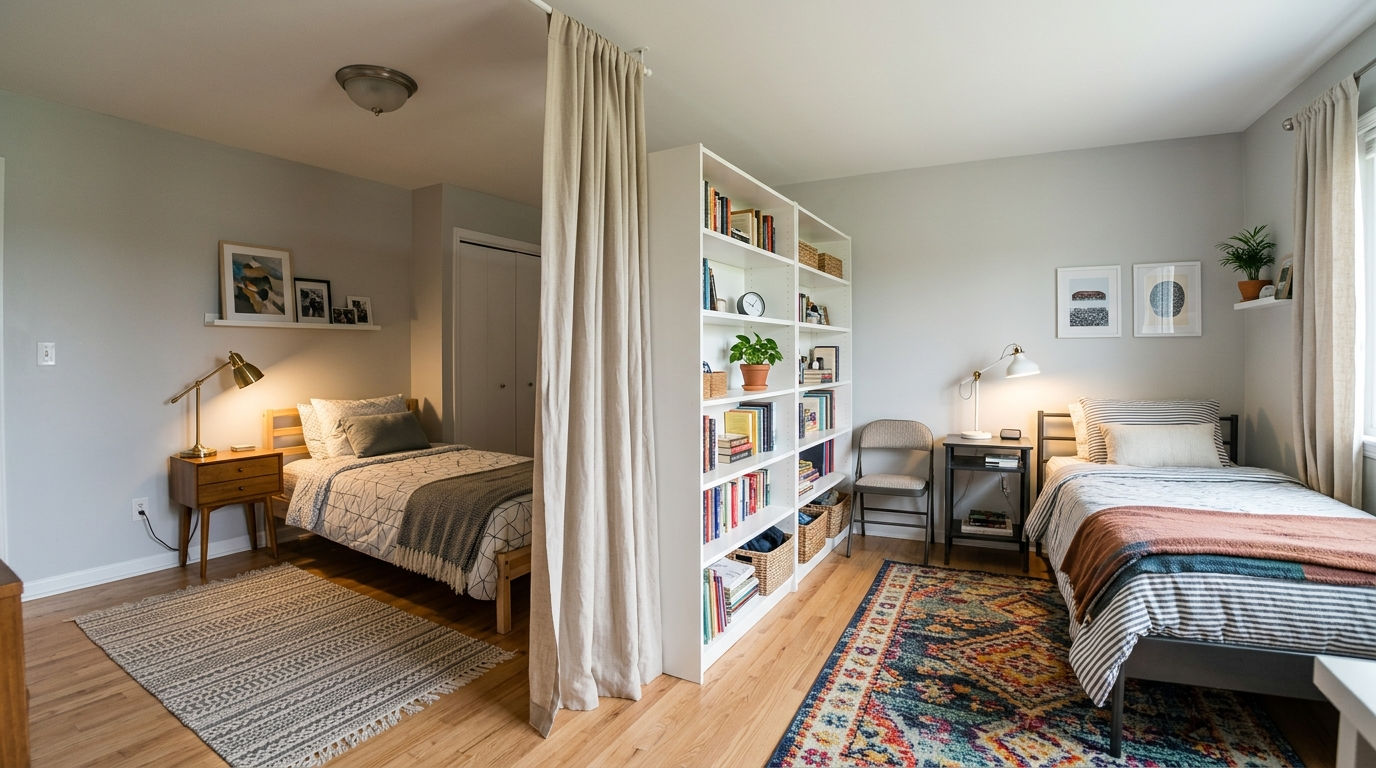
If budget is your primary concern, a curtain divider is hands-down the most accessible solution. A ceiling-mounted curtain track or a tension rod system can visually and semi-physically divide a room in hours — no tools, no permits, no mess.
How to Set It Up
- Choose your curtain track system. Look for ceiling-mounted curtain tracks with a bendable or modular design. Brands like IKEA (KVARTAL series) or industrial ceiling track kits from Amazon work well and are affordable.
- Measure your room carefully. Determine exactly where you want the dividing line, keeping in mind both sides need adequate space for furniture, airflow, and natural light.
- Install the track. Most systems screw into ceiling joists. Use a stud finder to locate joists before drilling, and always use appropriate anchors if you can’t hit a joist.
- Select your curtains. Thick, floor-to-ceiling curtains provide the best sense of separation and some sound dampening. Blackout curtains are excellent for creating a sleeping space behind the divide.
- Hang and adjust. Once hung, you have an instantly functional room divider that can be opened or closed as needed.
Pros
- Extremely affordable
- Requires minimal tools and skill
- Fully reversible — great for renters
- Can be decorative and stylish
Cons
- Minimal soundproofing
- No real security between the two spaces
- May look informal in some contexts
Method 2: Bookshelf or Shelving Unit Dividers — Functional and Stylish
Estimated Cost: $80–$400
A large, freestanding bookshelf positioned perpendicular to the wall is a classic room-dividing trick that also adds valuable storage. This method works best in rooms that are at least 12 feet wide so both sides retain a sense of space.
How to Do It Right
- Choose tall, open-backed shelving. Open shelving units (no backing) allow light to pass through and feel less visually heavy. IKEA’s KALLAX or BILLY series are budget-friendly favorites.
- Anchor it to the wall or ceiling for safety. A freestanding shelf can tip, especially in homes with children. Use anti-tip brackets or ceiling anchors to secure it.
- Style with intention. Use the shelves for books, plants, baskets, and décor on both sides. This makes it feel like a design feature rather than an afterthought.
- Consider a double-sided unit. Some shelving designs allow items to be displayed from both sides, maximizing utility for both newly formed rooms.
Pros
- Adds significant storage
- Visually attractive and design-forward
- Creates a more solid sense of separation than curtains
- Affordable, especially with flat-pack furniture
Cons
- Not truly private — sound and light pass through
- Fixed position once furniture and items are loaded
- Requires careful weight balancing and wall anchoring
Method 3: Folding Room Dividers and Screens — Maximum Flexibility
Estimated Cost: $50–$300
Folding screens have been used for centuries to divide spaces, and they remain one of the most versatile budget-friendly solutions available today. Modern versions come in wood, rattan, fabric panels, and even mirrored or frosted glass designs.
Tips for Using Folding Screens Effectively
- Go floor-to-ceiling if possible. Taller panels (6–8 feet) create a much stronger sense of division than shorter decorative screens.
- Link multiple panels together. You can join two or three folding screens for wider room coverage.
- Layer with curtains. Placing a sheer curtain behind a folding screen adds depth and increases privacy without additional cost.
- Use mirrors strategically. A screen with mirrored panels on one side can make a smaller divided space feel larger.
Pros
- Maximum flexibility — can be repositioned or removed in minutes
- Wide variety of styles available
- No installation required
- Great for renters
Cons
- Limited soundproofing or true privacy
- May not be stable in high-traffic or family environments
- Not ideal for permanent arrangements
Method 4: Glass or Acrylic Panel Dividers — Modern and Light-Preserving
Estimated Cost: $100–$600
One of the biggest concerns when dividing a room is losing natural light. Glass or frosted acrylic panel dividers are an elegant solution — they create a clear visual boundary while still allowing light to travel through both spaces.
How to Source and Install Them
- Acrylic sheets are much cheaper than glass and can be cut to size at most hardware stores. They’re also lighter and safer.
- Use a simple frame. Build or buy a wooden or metal frame and secure the acrylic panels within it. This creates a freestanding room divider that can be moved.
- Frosted film on clear acrylic is a budget-friendly upgrade. You can apply frosted window film (available for $10–$20 per roll) to create privacy while still diffusing light beautifully.
- Floor track systems are available from flooring and home improvement stores and allow glass or panel dividers to slide, making them both functional and space-efficient.
Pros
- Preserves natural light — a major advantage in smaller rooms
- Looks clean, modern, and intentional
- Can be made semi-permanent with the right framing
- Great for home offices that share space with bedrooms
Cons
- More expensive than fabric or wood solutions
- Limited sound privacy
- Requires some DIY skill for framing
Method 5: Build a Non-Load-Bearing Stud Wall — The Most Permanent Solution
Estimated Cost: $200–$800 (DIY) | $800–$2,500+ (Contractor)
If you want genuine privacy, soundproofing potential, and a real “second room” feel, building a non-load-bearing stud wall is the way to go. This is the only method that truly creates two separate rooms.
Is a Permit Required?
This depends entirely on your local municipality. In many areas, interior non-load-bearing partition walls don’t require a permit, but rules vary widely. Always check with your local building authority before starting. If you’re renting, you’ll obviously need landlord approval.
Step-by-Step Overview
- Plan your layout. Decide where the wall will go, making sure both rooms will have access to at least one window and an electrical outlet. Consider door placement carefully.
- Gather materials. You’ll need 2×4 lumber (for the top plate, bottom plate, and studs), drywall sheets, drywall screws, joint compound, sandpaper, and a door frame kit if adding a door.
- Frame the wall. Build the frame on the floor first — top plate, bottom plate, and vertical studs spaced 16 inches apart. Then tilt it into place and secure it to the floor, ceiling joists, and any adjacent walls.
- Add insulation (optional but recommended). Rockwool or fiberglass batt insulation between studs dramatically improves soundproofing. This is especially important if one space will be a sleeping area.
- Hang and finish drywall. Screw drywall sheets to both sides of the frame. Tape and mud the seams, sand smooth, prime, and paint.
- Install the door. A pre-hung interior door kit makes this step much more manageable for DIYers.
Budget-Saving Tips for Stud Wall Construction
- Buy lumber in bulk and have it cut at the hardware store.
- Rent tools (like a drywall lift) rather than buying them.
- Watch tutorials — YouTube has excellent step-by-step guides from professional contractors.
- Do the finishing work yourself. Even if you hire a framer, sanding and painting yourself saves significant money.
Pros
- Creates a genuinely separate room
- Best soundproofing potential of any method
- Adds real-estate value (in owned homes)
- Can include a lockable door for true privacy
Cons
- Most expensive and time-consuming option
- May require permits
- Not reversible without significant repair work
- Not suitable for renters without landlord consent
Key Considerations Before You Start Any Room Division Project
1. Light and Ventilation
Dividing a room can leave one or both sides without a window. Always ensure both new spaces have adequate natural light and ventilation. If windows are scarce, consider how you’ll supplement with artificial lighting and whether a ceiling fan or portable air solution is needed.
2. Electrical Outlets and Switches
Most rooms have outlets only on the perimeter walls. When you divide a room, at least one side may end up with limited or no accessible outlets. Factor in extension cord management or, for permanent walls, consult an electrician about adding outlets safely.
3. Heating and Cooling
HVAC vents are designed for open floor plans. When you divide a room, airflow can become uneven. Make sure each new space has at least one vent, or plan for supplemental heating/cooling (a small space heater or portable fan) if needed.
4. Building Codes and Rental Agreements
Even “temporary” modifications can violate rental agreements. Always get written permission from your landlord before making changes, regardless of how minor they seem. For homeowners, check local building codes particularly for any permanent structural work.
5. Ceiling Height
Standard room dividers, curtain tracks, and partition walls work best in rooms with ceilings of at least 8 feet. Low ceilings can make divided spaces feel cramped. Measure before committing to any solution.
Smart Layout Tips to Maximize Both New Spaces
Once you’ve chosen your dividing method, thoughtful furniture placement makes a huge difference in how usable and comfortable each new space feels.
- Use vertical space. Loft beds, tall wardrobes, and wall-mounted shelving free up precious floor space in smaller divided areas.
- Choose multi-functional furniture. Sofa beds, Murphy beds, ottoman storage, and foldable desks are invaluable in compact rooms.
- Mirror placement. Strategically placed mirrors on walls opposite windows create the illusion of a larger, brighter space.
- Keep color palettes light. Light walls, ceilings, and flooring reflect more light, making divided spaces feel less confined.
- Rugs define zones. Even without a divider, a distinctive area rug in each space reinforces the sense of two separate rooms.
Budget Comparison at a Glance
| Method | Estimated Cost | Privacy Level | Permanence | Renter-Friendly |
|---|---|---|---|---|
| Curtain Divider | $30–$150 | Low | Temporary | ✅ Yes |
| Bookshelf Divider | $80–$400 | Low–Medium | Semi-permanent | ✅ Yes |
| Folding Screen | $50–$300 | Low | Temporary | ✅ Yes |
| Glass/Acrylic Panel | $100–$600 | Medium | Semi-permanent | ⚠️ Maybe |
| Stud Wall | $200–$2,500+ | High | Permanent | ❌ No |
Final Thoughts: Choose the Method That Matches Your Life
Dividing one bedroom into two separate rooms doesn’t have to mean a full renovation or a massive budget. From a $40 curtain rail to a $500 DIY stud wall project, there’s a solution for every situation, skill level, and financial reality.
Start by being honest about your goals — how much privacy do you really need? Is this a short-term fix or a long-term arrangement? Are you renting or do you own the space? Your answers will point you directly to the right method.
Then, execute with intention. Measure carefully, plan your layout, and invest a little extra thought into lighting, ventilation, and furniture placement. A well-divided room won’t just feel like two smaller spaces — it can feel like two completely distinct, comfortable places to live and work.
With patience, creativity, and the right approach, you can absolutely make it happen on a budget.

Sarah Rose writes for EcoGardeningHub, sharing eco home decor ideas, sustainable styling tips, and simple ways to create beautiful, nature-inspired living spaces with a mindful, environmentally friendly approach.