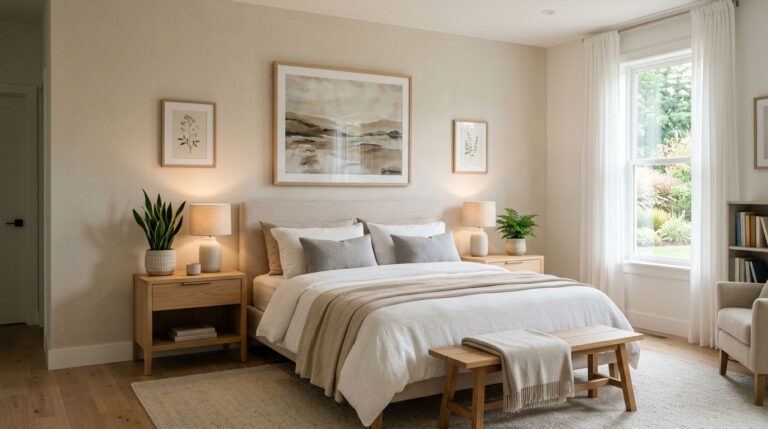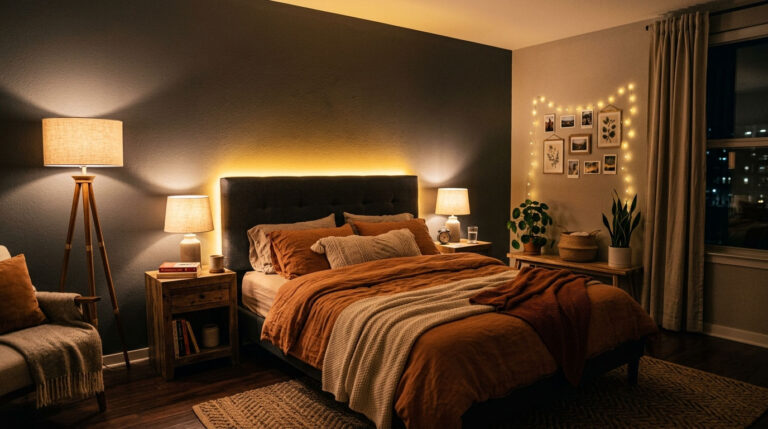
How to Paint an Accent Wall in a Small Bedroom with Two Colors (Complete Guide)
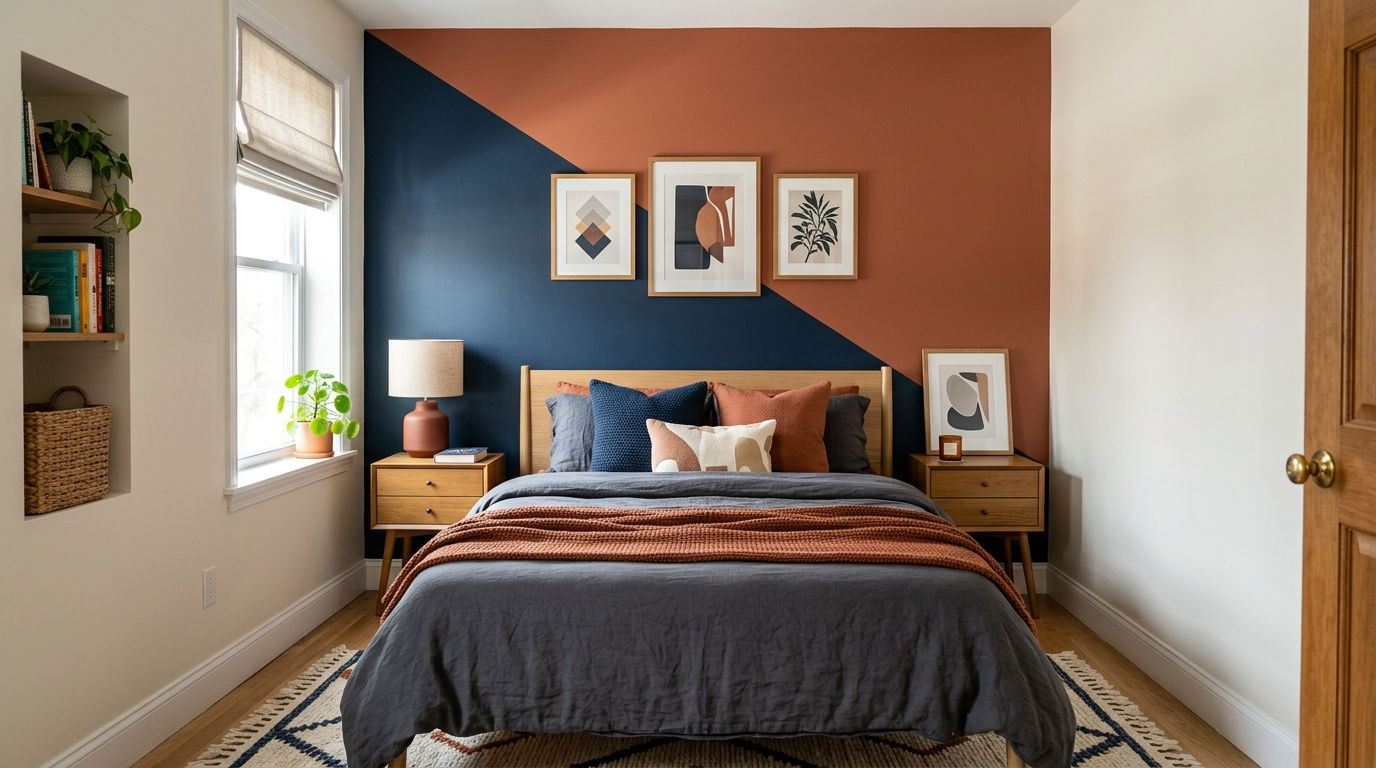
An accent wall is one of the most impactful and cost-effective upgrades you can make to a small bedroom. Done right, it adds depth, personality, and visual structure to a room that might otherwise feel flat or underdefined. Done wrong — with a color that fights the rest of the room, or a technique executed sloppily — it can make a small space feel chaotic and even smaller.
The two-color accent wall takes the concept a step further. Instead of a single block of color on one wall, you’re working with two colors together — either as a split wall, a geometric design, a painted arch, a color-blocked panel, or a striped pattern. It sounds ambitious, but with the right preparation and a clear plan, it’s absolutely achievable for a DIY painter of any skill level.
This guide walks you through everything: how to choose your two colors, which wall to paint, every popular two-color technique with step-by-step instructions, how to prep and tape properly, and how to avoid the mistakes that trip up first-timers.
Why a Two-Color Accent Wall Works Especially Well in Small Bedrooms
The instinct with a small bedroom is often to keep everything as light and uniform as possible — pale walls, matching everything, no bold moves. It’s a safe approach, but it often produces rooms that feel anonymous rather than cozy.
A two-color accent wall breaks this pattern strategically. By concentrating visual interest on one wall, you give the room a focal point without overwhelming the entire space. The eye lands on the accent wall, reads it, and then the surrounding lighter walls feel more expansive by contrast.
The two-color approach adds another layer of sophistication: it creates visual dimension that a single flat color can’t achieve. Two colors — whether separated by a crisp geometric line, blended in an ombré effect, or arranged in stripes — suggest craft and intentionality. A bedroom with a well-executed two-color accent wall rarely looks “DIY.” It looks designed.
Step 1: Choose the Right Wall
Before you choose colors or techniques, decide which wall will be your accent wall. This decision shapes everything that follows.
The Classic Choice: The Wall Behind the Bed
In most bedrooms, the wall the headboard sits against is the natural accent wall. It frames the bed — the visual and functional centerpiece of the room — and creates the impression of an architectural moment even in the most ordinary apartment bedroom.
This is the right choice for most people. If in doubt, start here.
When to Consider Another Wall
Sometimes the headboard wall isn’t the best option:
If the headboard wall has a window: A window interrupts the painted surface and can make a two-color design look awkward. In this case, choose the wall opposite the bed — the first thing you see when you enter the room.
If the headboard wall is very short or has an odd shape: Sloped ceilings, dormers, or built-in shelving can complicate the design. A flat, uninterrupted wall is ideal for a clean two-color treatment.
The wall you see from the door: The wall directly opposite the bedroom door is what registers as the room’s first impression. This can be a powerful accent wall choice, especially in a long narrow room.
Walls to Avoid
Don’t paint an accent wall on a wall that’s heavily interrupted by doors, windows, switches, and vents — the design gets chopped up and loses its effect. You want as much unbroken surface as possible for a two-color treatment to read properly.
Step 2: Choose Your Two Colors
Color selection is where the project succeeds or fails before a drop of paint is applied. Two-color accent walls live or die by the relationship between the colors.
The Three Types of Two-Color Relationships
Tone-on-tone: Two shades of the same color family — a light dusty blue and a deeper navy, or a warm cream and a rich terracotta. This approach is the most forgiving and produces the most elegant results. The colors are related enough to feel cohesive but different enough to create visible contrast.
Complementary contrast: Two colors from opposite sides of the color wheel — teal and burnt orange, navy and mustard, sage and blush. This creates a more vibrant, energetic accent wall. Use this when you want the wall to make a real statement.
Neutral plus one: One true neutral (white, cream, gray, or black) paired with one color. This is classic and almost always works. The neutral grounds the color and makes it feel intentional rather than overwhelming.
How to Choose Colors That Work With Your Existing Room
Your two accent colors don’t exist in a vacuum — they need to work with your bedding, furniture, curtains, and flooring. Before committing to any colors, look at what’s already in the room.
Pull the dominant colors from your bedding or rug and build from there. If your duvet is a warm ivory with sage green detail, a sage and cream two-tone wall is a natural extension. If your furniture is warm walnut wood, earthy terracotta and cream on the wall will feel cohesive.
Take paint swatches home and hold them against your existing furniture and textiles in the actual room, in natural daylight. Colors look completely different in a store under fluorescent lighting than they do in your bedroom.
The 60-30-10 Rule Applied to a Two-Color Wall
A useful guiding principle: in a two-color design, let one color occupy roughly 60–70% of the wall and the other occupy 30–40%. Visual equality — two colors split precisely 50/50 — can feel static and indecisive. A clear dominant and secondary creates hierarchy and rhythm.
Undertones Matter More Than You Think
Paint colors have undertones — hidden notes of warmth or coolness that only become visible against other colors or in certain lights. A “gray” paint might have purple undertones that clash with your warm wood furniture. A “white” might have yellow undertones that make your bright white trim look dingy.
When choosing two colors for the same wall, make sure their undertones are compatible. Both warm, or both cool. Mixing a warm-toned color with a cool-toned color on the same wall creates a subtle discomfort that’s hard to identify but impossible to ignore.
Step 3: Choose Your Two-Color Technique
This is where you decide not just what colors but how they’ll relate to each other on the wall. Here are the most popular and achievable two-color techniques for a small bedroom accent wall.
Technique 1: Horizontal Split (Half-and-Half)
What it is: The wall is divided horizontally at a specific height — most commonly at chair rail height (32–36 inches from the floor) or at the midpoint of the wall. One color goes below the line, the other above.
The effect: Classic, structured, and architectural. The lower half in a deeper color grounds the room and makes the ceiling feel taller. The upper half in a lighter color opens the space upward. This is one of the most popular techniques for small rooms precisely because it creates the illusion of height.
Best color pairing for this technique: A deeper or richer color on the bottom half, a lighter or neutral color on the top half. Reversing this (dark on top) can make a small room feel heavy and oppressive.
The dividing line: You can leave a clean painted line, add a strip of contrasting trim, or apply a band of metallic or contrasting paint as a transition. Even a half-inch band of gold or white between the two colors elevates the look significantly.
Technique 2: Vertical Split (Side-by-Side)
What it is: The wall is divided vertically — either down the center or at an off-center position — with a different color on each side.
The effect: More modern and graphic than a horizontal split. An off-center vertical line (dividing the wall roughly 40/60 or 30/70) is more dynamic than dead center.
Best for: Rooms with a geometric or contemporary aesthetic. Works beautifully behind a bed when the dividing line is centered on the headboard, creating the impression of a color-blocked headboard accent.
Watch out for: The vertical split is less forgiving than the horizontal because the line has to be truly vertical — not just eye-level straight. Any deviation is very visible. Use a plumb line or a long spirit level, not just your eye.
Technique 3: Geometric Shapes and Panels
What it is: A defined geometric shape — a large rectangle, square, arch, diamond, or triangle — is painted in a contrasting color within the main color field.
The effect: Sophisticated and intentional. A painted arch above the bed is particularly popular right now — it frames the headboard in a soft architectural form and looks like an expensive design detail when done well.
Best for: Any room style, depending on the shape you choose. Arches suit boho, romantic, or eclectic rooms. Clean rectangles and squares suit minimalist or contemporary spaces. Bold triangles or diamonds suit more graphic, energetic rooms.
How to execute the arch: Use a piece of string pinned to the wall as a compass to draw your arch lightly in pencil. The string length equals the radius of your arch. Swing it in a half-circle to mark the curve, then tape along the pencil line carefully (use a flexible painter’s tape that can follow curves) before painting.
How to execute a rectangle panel: Decide on the panel size, measure and mark the four corners lightly in pencil, use a level to connect them into perfectly straight lines, and tape precisely along those lines.
Technique 4: Color Blocking
What it is: Bold, irregular blocks of color — like large abstract rectangles or irregular shapes — painted across the wall without following strict geometric rules.
The effect: Artistic, playful, and contemporary. More expressive than precise geometric techniques.
Best for: People with confidence in their artistic instincts and rooms with a creative, eclectic aesthetic. Less suited to minimalist or traditional rooms.
Execution tip: Sketch your color block arrangement on paper first. Even “informal” color blocking benefits from planning the proportions and placement before you pick up a brush.
Technique 5: Horizontal Stripes
What it is: Multiple horizontal stripes in alternating colors, running the full width of the wall.
The effect: Makes a wall feel wider and the room feel more expansive horizontally. Works best with stripes of similar width in colors that are close in tone (both light, or one very slightly deeper than the other) rather than high-contrast stripes that can feel busy.
Best for: Small rooms where you want to enhance the sense of width. Also excellent for maximizing a low-ceilinged room’s width visually.
Execution: Horizontal stripes require careful, precise taping. Use a level to mark each stripe edge lightly in pencil before taping. Consistent stripe widths are critical — even a quarter-inch variation is visible once the tape is removed. Use a tape measure, not your eye.
Step 4: Gather Your Supplies
Before any prep work begins, gather everything you need. Stopping mid-project to make a store run breaks momentum and increases the chance of mistakes.
The Supply List
Paint:
- Paint in Color 1 (your base/dominant color)
- Paint in Color 2 (your secondary/accent color)
- Both in the same finish — eggshell or satin for bedroom walls (not flat/matte, which is harder to clean; not high-gloss, which shows every wall imperfection)
Prep and protection:
- Painter’s tape — blue or green (ScotchBlue is the standard; Frog Tape offers better bleed prevention for crisp lines)
- Drop cloth or old sheets to protect the floor
- Plastic sheeting to protect furniture if needed
- Sandpaper (220-grit for light wall smoothing)
- Spackle and a putty knife (for any holes or divots)
- TSP cleaner or sugar soap (for washing walls before painting)
Painting tools:
- 2-inch angled paintbrush (for cutting in edges)
- 9-inch roller frame
- Roller covers: 3/8-inch nap for smooth walls, 1/2-inch nap for slightly textured walls
- Paint tray and liner
- Small foam roller (useful for tight areas)
- A stir stick
Measuring and marking:
- Tape measure
- Level (a 4-foot level is ideal; a torpedo level works for smaller jobs)
- Pencil
- Chalk line (for very long straight lines)
- String (for drawing arches)
Step 5: Prep the Wall Properly
Preparation is the step that separates a professional-looking result from an amateur one. Skipping or rushing prep is the single most common mistake DIY painters make.
Clean the Wall
Wash the entire accent wall with a mild TSP cleaner or sugar soap solution and a sponge. This removes dust, oils, and grime that would prevent paint from adhering properly. Let the wall dry completely — at least two hours, ideally overnight.
Repair Any Damage
Inspect the wall closely for holes, dents, cracks, and divots. Even small imperfections are magnified by paint, especially in raking light (light hitting the wall at a low angle). Fill everything with spackle, let it dry completely, then sand it smooth with 220-grit sandpaper. Wipe away sanding dust with a damp cloth.
Prime If Needed
Priming is necessary when:
- You’re painting a dark color over a lighter one (or vice versa with a significant value jump)
- The wall has stains that could bleed through
- You’ve made repairs that exposed the raw drywall
Use a tinted primer matched roughly to your paint color for best coverage. One coat of primer before your paint coat saves you from needing three or four paint coats to achieve solid coverage.
Protect Everything Else
Lay your drop cloth along the base of the wall. Use painter’s tape to protect the ceiling line, baseboards, adjacent walls, and any trim. Press the tape edge down firmly — run a putty knife or credit card along the edge to seat it properly. This prevents paint from bleeding underneath.
Step 6: Paint the Base Color First
Whatever your two-color technique, always paint the base color (the dominant color, or the background color your design will be painted onto) first.
Apply the base color across the entire accent wall with roller and brush. Cut in the edges carefully with your angled brush, then roll the main field in overlapping W or M patterns to ensure even coverage.
Most paints require two coats for solid, even coverage. Let the first coat dry completely before applying the second — typically 2–4 hours depending on the paint and humidity. Don’t rush this.
Once the base coat is fully applied and dry (wait at least 24 hours before the next step), you’ll apply your second color.
Step 7: Mark, Tape, and Paint the Second Color
This is the critical step where your design comes to life — and where precision matters most.
Marking Your Design
Using your measurements, level, and pencil, mark your design lightly on the wall. For a horizontal split, mark the dividing line at even intervals across the wall and connect them with a chalk line or a long level. For a panel or arch, mark the full outline. For stripes, mark both edges of each stripe.
Check everything with a level before taping. Check it again. A line that looks right to the eye is frequently not plumb or level — trust the tool.
Applying Tape
Apply painter’s tape precisely along your pencil marks. The tape goes on the side of the line that will be your base color — the side you want to protect. The edge of the tape is the edge of your second color.
Press the tape edge down very firmly. Run your finger along it, then run a card or putty knife along it again. The leading edge of the tape is the only thing preventing bleed, and it only works if it’s fully adhered.
For curves and arches: Use Frog Tape’s curved tape or score standard painter’s tape with small cuts every half inch so it bends. Apply in small sections, pressing carefully.
For very crisp lines: After taping, paint a thin coat of your base color along the tape edge before applying the second color. This seals the tape edge with the base color — if any paint bleeds under the tape, it bleeds the same color you started with, making it invisible. This is a professional painter’s trick and it works.
Painting the Second Color
Apply the second color with a brush and roller the same way you did the base coat. Cut in carefully along the tape edge — don’t overload the brush, and don’t press it into the tape so hard that paint works underneath.
Apply in thin, even coats. Two thin coats are always better than one thick coat, which drips, runs, and takes forever to dry.
Removing the Tape — The Most Important Moment
Remove the tape while the paint is still slightly wet — not fully dry. Waiting until paint is completely cured causes it to bond to the tape, and removing it pulls the paint edge with it.
Pull the tape back on itself at a 45-degree angle, slowly and steadily. Never pull straight out from the wall. Slow and steady prevents the edge from tearing.
If you see any bleeding or uneven edges after tape removal, touch up immediately with a small angled brush and the appropriate color while everything is still fresh.
Step 8: Finishing Touches and Clean-Up
Once both colors are applied and the tape is off, step back and evaluate the wall from across the room and from the doorway.
Look for: uneven coverage, visible roller lines, bleed marks along the color divide, and any areas the roller didn’t fully reach. Touch up everything with a small brush before cleaning up.
Clean-Up
- Wash brushes and rollers immediately with warm soapy water if using latex/water-based paint
- Seal leftover paint tightly with the lid hammered down — store upside down to prevent a skin from forming on the surface
- Remove drop cloths and tape
- Replace furniture and wall decor
The Reveal
Once the room is reassembled, make the bed, arrange the room, and look at the finished wall with fresh eyes. Two-color accent walls often look even better once the room is styled — the wall integrates with the bedding, furniture, and decor in ways that are hard to visualize during the process.
Common Mistakes to Avoid
Skipping the wall washing. Paint on a dirty wall peels. Always wash first.
Using cheap painter’s tape. Bargain tape bleeds more, tears more, and is harder to work with. Use ScotchBlue or Frog Tape — the extra couple of dollars is worth it.
Removing tape when dry. Dry paint tears along the edge. Pull tape while the paint is still slightly tacky.
Not letting coats dry fully. Impatience is the most common cause of streaky, uneven coverage. Follow the manufacturer’s drying times between coats.
Eyeballing lines instead of measuring. Your eye cannot reliably detect a line that’s half an inch off level. Your level can. Use the tool.
Choosing colors without testing in the room. Always test paint on the actual wall in large swatches (at least 12×12 inches) and evaluate at different times of day. Colors shift dramatically between morning and evening light.
Using flat/matte paint in a bedroom. Flat paint shows every mark and is difficult to clean. Use eggshell or satin for walls you’ll want to wipe down.
Two-Color Combinations That Work Beautifully in Small Bedrooms
To spark some inspiration, here are pairings that work especially well for small bedroom accent walls:
Warm white and terracotta: Timeless and earthy. The warmth of terracotta makes a small room feel cozy without feeling dark.
Sage green and cream: Soft, natural, and calming. Works with nearly any furniture style.
Navy and soft gold: Classic and dramatic. The navy grounds the room; the gold adds warmth and light.
Dusty rose and warm gray: Romantic and sophisticated. The gray prevents the pink from feeling saccharine.
Charcoal and warm white: High contrast and modern. The charcoal creates depth; the white keeps the room from feeling heavy.
Deep teal and off-white: Rich and layered. Teal reads as both sophisticated and cozy in a small space.
Mustard and slate blue: Complementary colors that balance each other beautifully. Bold but grounded.
Final Thoughts
Painting a two-color accent wall in a small bedroom is one of those projects that feels intimidating before you start and deeply satisfying once it’s done. The transformation — from a plain box of a room to a space with genuine visual personality — happens in a single weekend.
The keys are simple: choose colors that work with your existing room, prep the wall properly before touching a brush, tape with precision and patience, and remove the tape at the right moment.
Everything else is just paint.

Sarah Rose writes for EcoGardeningHub, sharing eco home decor ideas, sustainable styling tips, and simple ways to create beautiful, nature-inspired living spaces with a mindful, environmentally friendly approach.